Roth

History

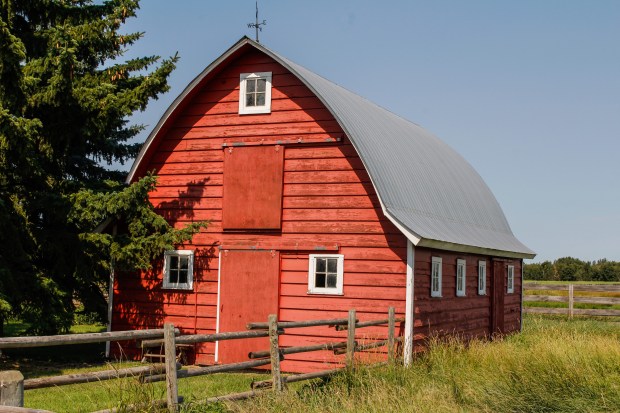
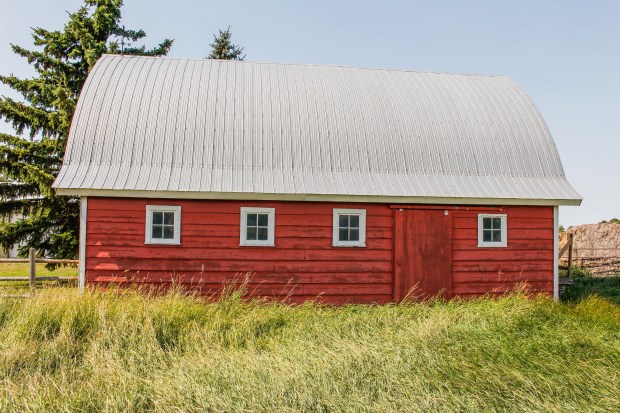
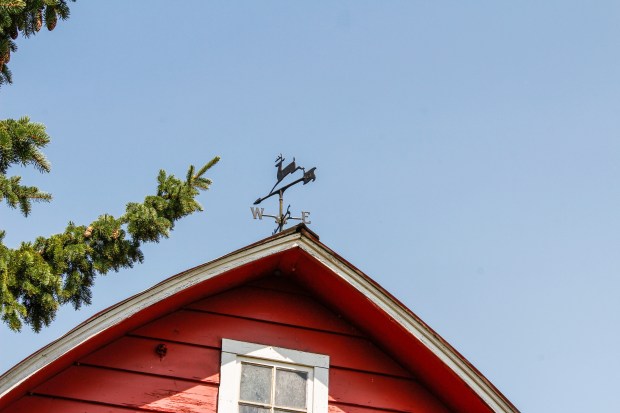
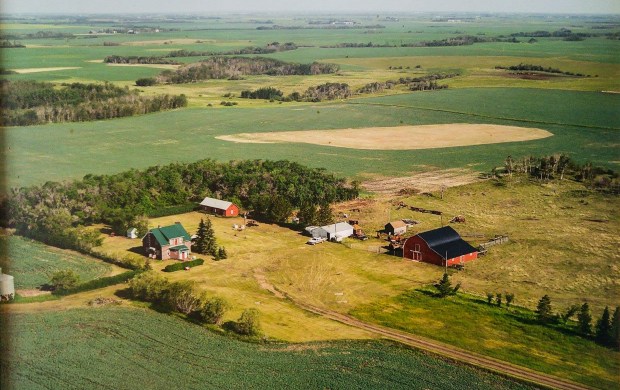
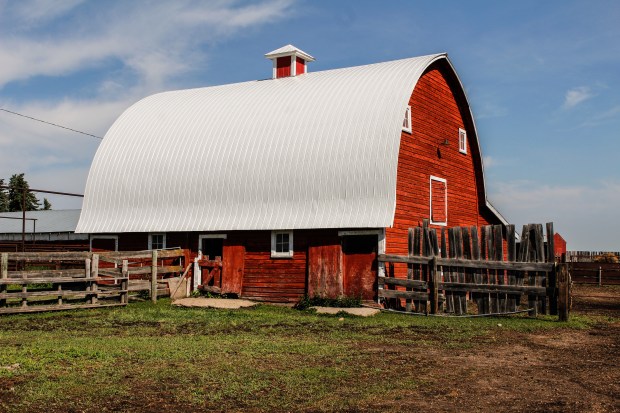
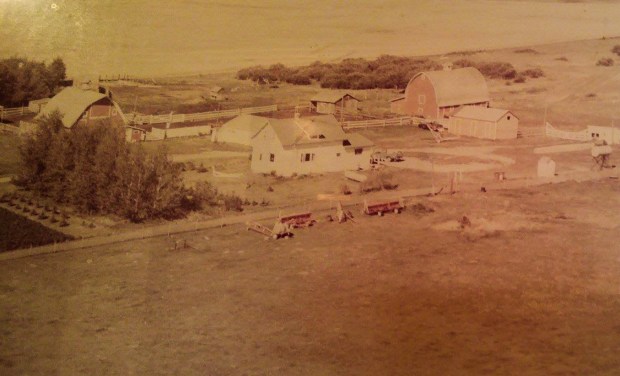
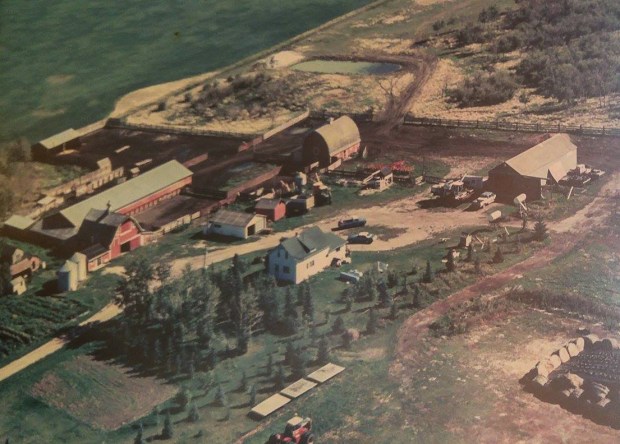
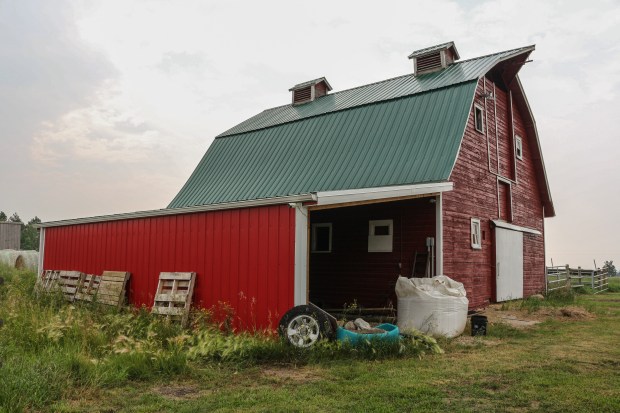
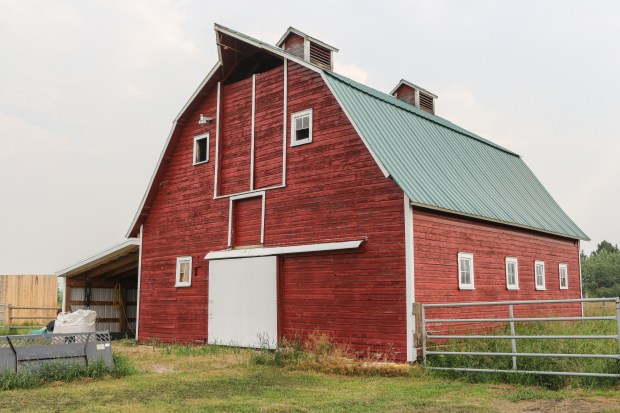
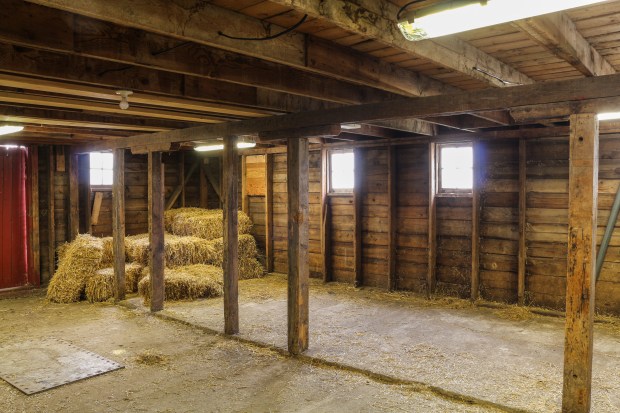
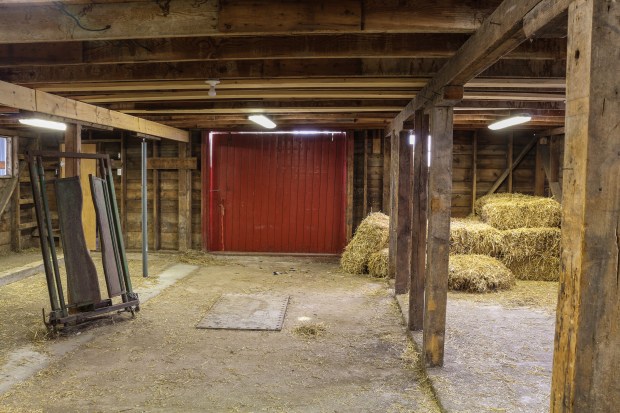
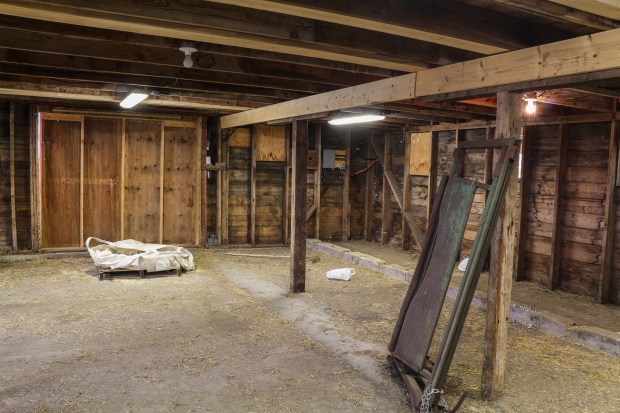
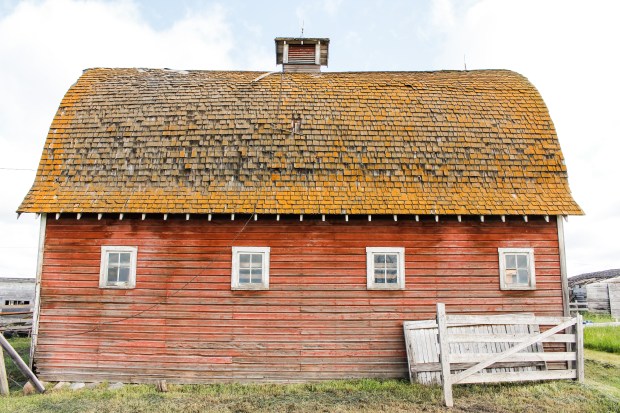
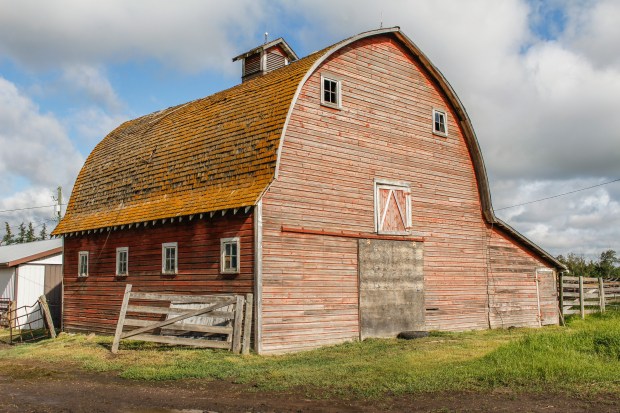
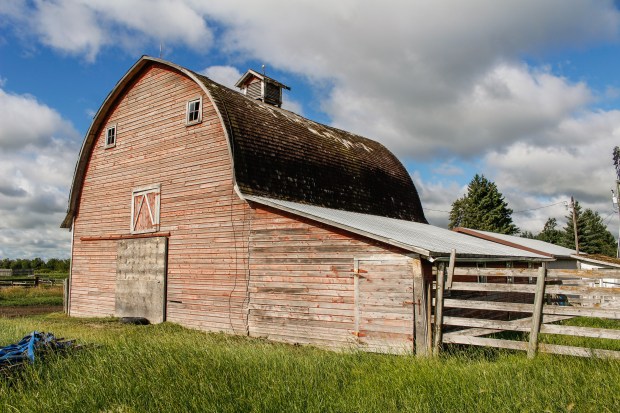
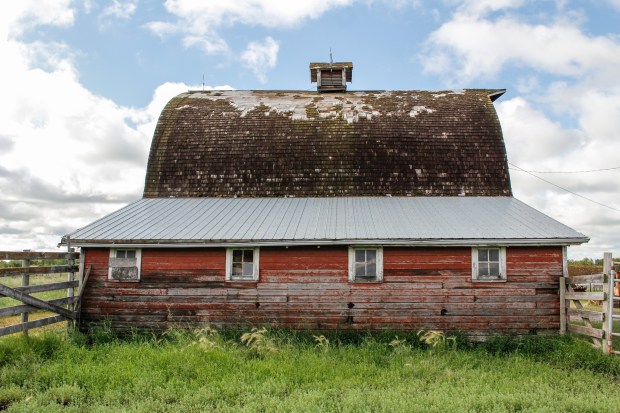
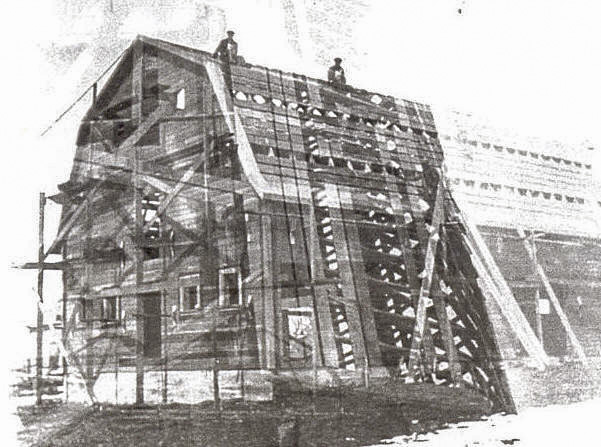
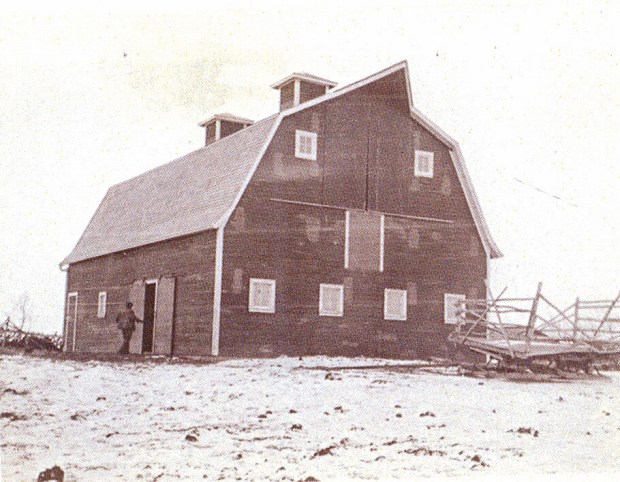
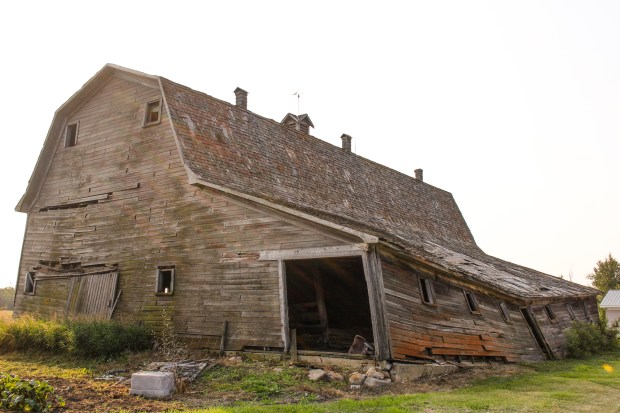
This barn was built in 1916 using frame construction and balloon framing. It is likely that Barney Schares had a hand in building it. Barney built many barns in the Heisler area and this barn is very similar to his other barns. The barn was constructed by the Roth family to replace an old log barn that stood in the yard prior to 1914. Perhaps Barney Schares just provided the blue print and know-how to the Roth family. We do know for certain that the new barn was built with the help of friends and neighbours.

Burkhard and Augustine Roth came to the Heisler area in 1904 from North Dakota. They officially homesteaded a quarter section of land 2 miles west of the property this barn sits on. Homestead rules stated that a family could live on a piece of land within 2 miles of their homestead quarter. Burkhard had purchased the quarter this barn sits on, a CPR quarter, in 1903 from someone he knew in the States. He liked the CPR quarter better than his homestead land and so the family began residing there.

Burkhard, Augustine, and family moved to the outskirts of Cheweelah, Washington for 3 years, from 1911-1914. They rented out the land near Heisler while they were away to Joe Leeb. By that time, they had already had six children: Killian (died young), Annie, Martha, Carl, Herman, William. William Roth was only three-years-old at the time of the move and six-years-old when they moved back to the Heisler area. However, he remembers that he didn’t like the mountains very much. No, the prairie suited him better and so he was glad when the family made the trek home. Burkhard passed away in 1923 and William helped his mother on the family farm after that. In 1933, William married Mary Rakoz and the two lived on the quarter this barn stands on with Augustine until she moved to Heisler in 1935.

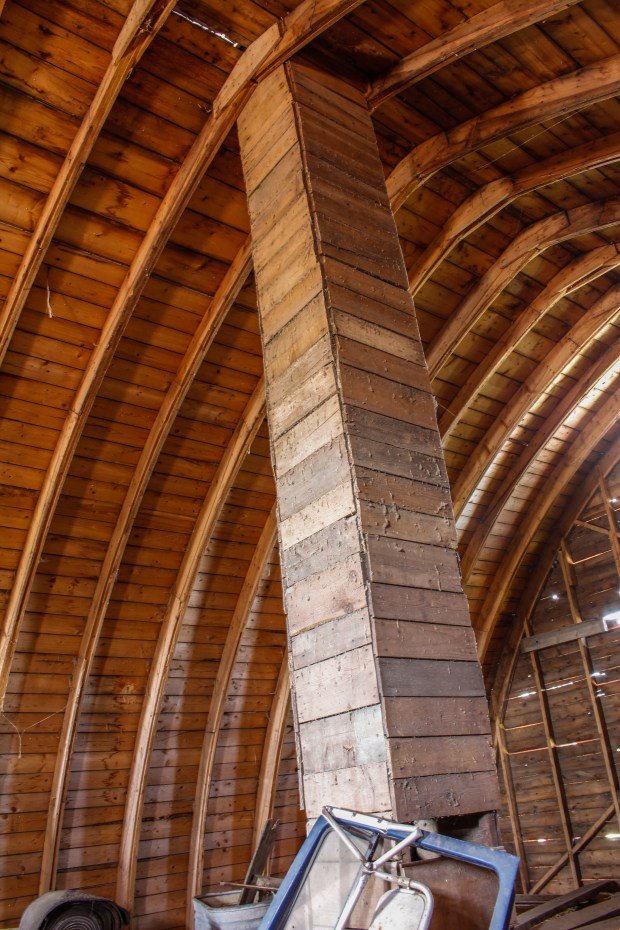
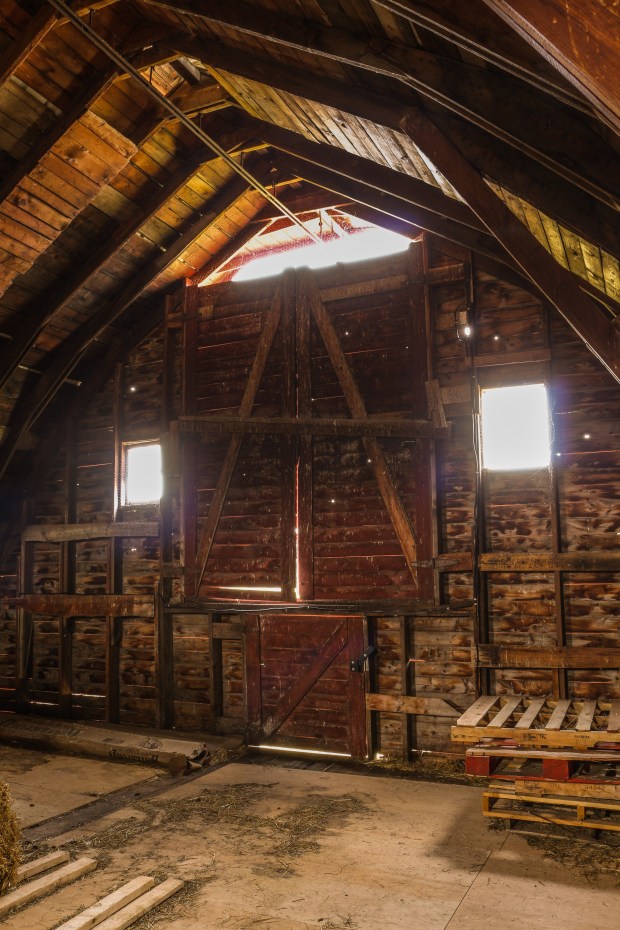
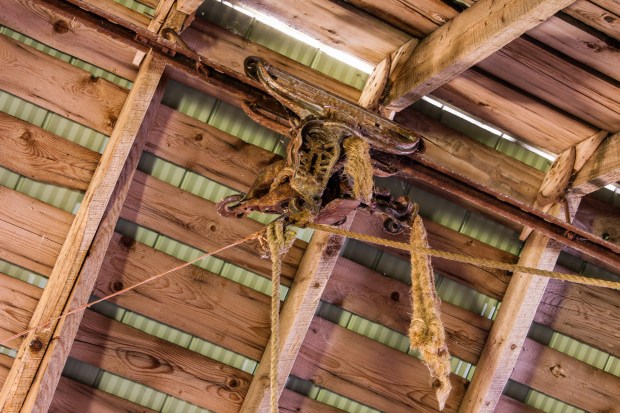
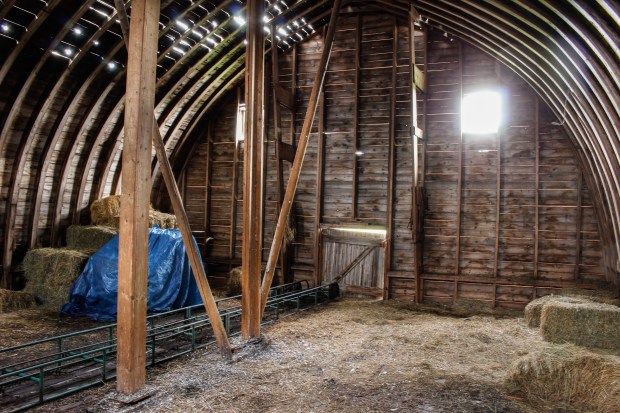
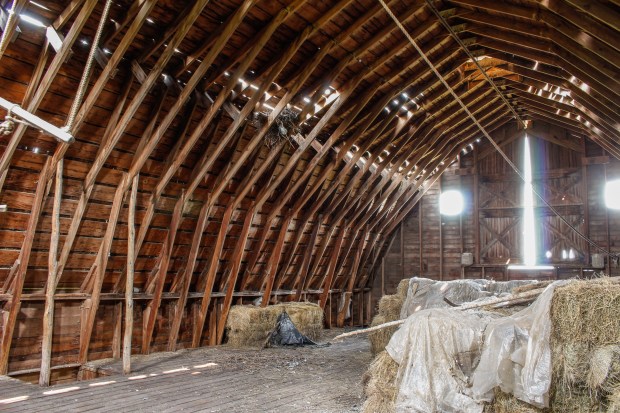
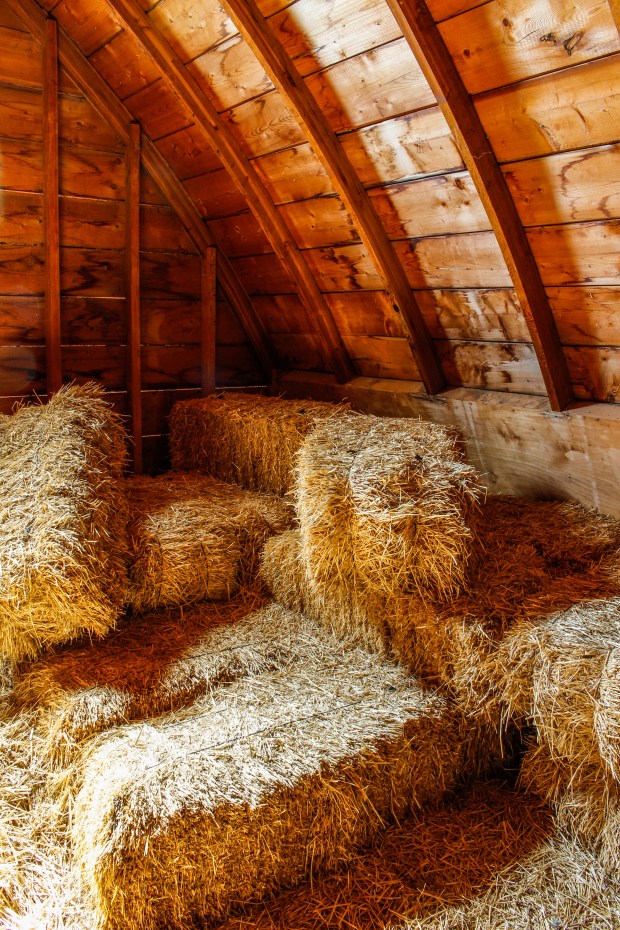
The barn was built 30 feet high for the storage of loose hay. There were no balers at the time of construction. Instead, the hay was cut with a mower, raked by horse drawn equipment into windrows, and forked by hand onto a hay wagon. When a full wagon of hay pulled in front of the barn, the southern loft door would be lowered and slings of hay would then be lifted into the loft by the horses. The hay carrier and all of its related systems accomplished this momentous task. If you wish to see a video of a hay carrier system in action or learn more about hay carriers please click here and scroll to the “Hay Carrier System” section.

The younger children of the Roth family got the job of following the hay sling to the back of the barn’s loft and pulling the trip rope that dropped the hay in the sling into a pile. Pull and run, so as not to get covered, was the trick. Randy Roth, William and Mary’s youngest child, remembers the loft being full to the roof’s peak with loose hay. He could then climb the pile up and get into the large wooden cupula to look out to the north to see the Spring Lake Church! Hay was forked down chutes into the mangers on the main level where the horses and cows would eat. All the children had the opportunity to fall through a chute at least once.

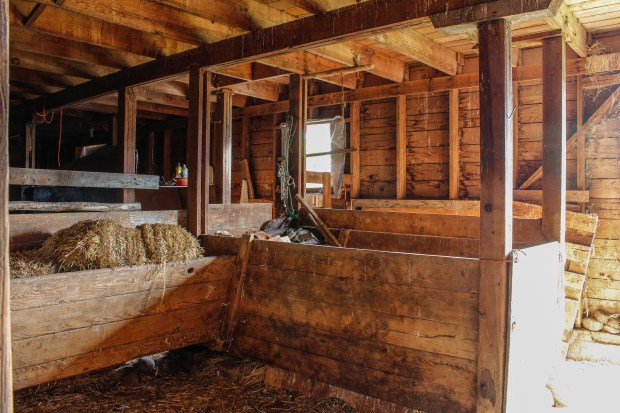
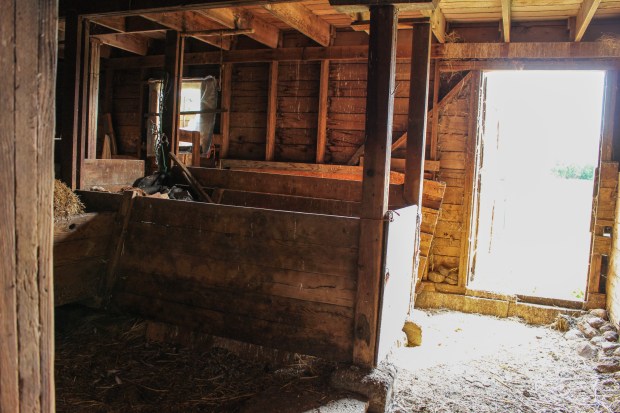
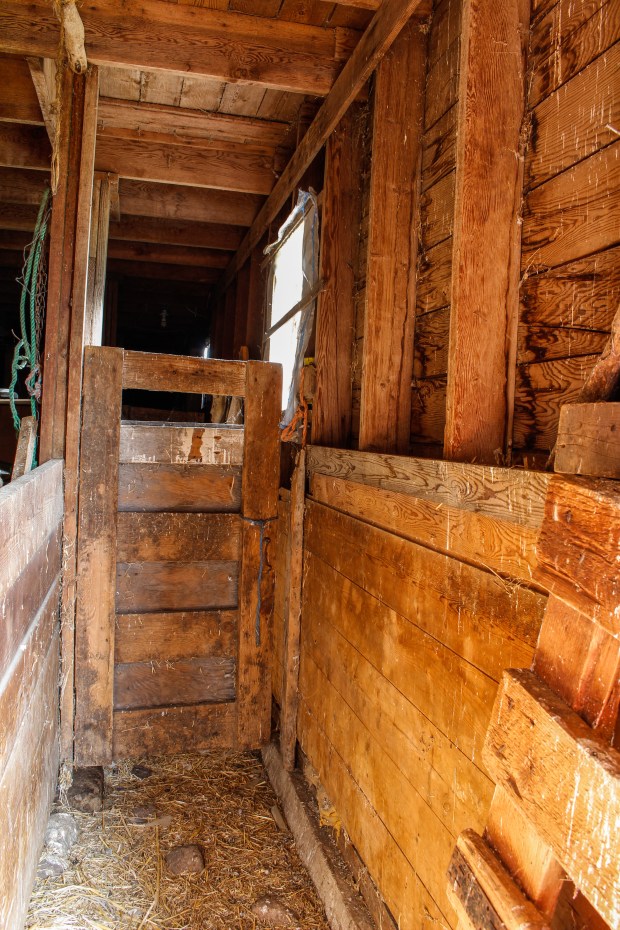
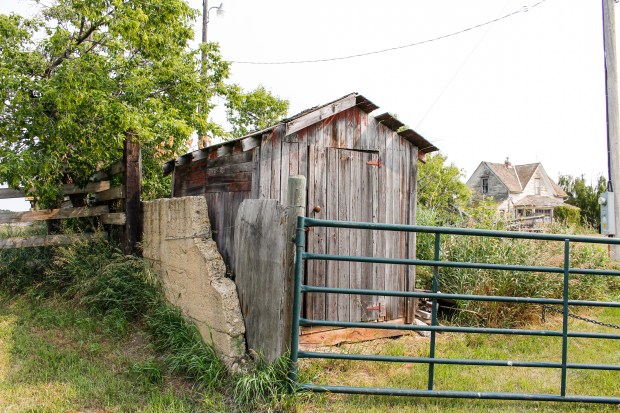
In the early years, the western shed housed the horses that were used to work the land and thus it is still known as the “horse barn.” Ken Roth, William and Mary’s oldest child, still remembers having to harrow with the horses. The main part of the barn was for cows. Milk from the cows in the early years was left to rest to allow the cream to rise to the top. Then the cream was skimmed off for making butter. Some cream and butter were taken to town to exchange for groceries. Later, a cream separator, first turned by hand with a crank and later powered by electricity, was used to obtain the cream. A cream truck would come from Sedgewick to pick up the cream and leave a cheque that was used for groceries. The milk was not sold but instead eaten by the family or given to the pigs.

Tractors came to the Roth farm in the early 1940’s so not as many horses were needed. The southern end of the “horse barn” was used for pigs and calves yet it was referred to, and is still referred to, as the “horse barn.” For many year, the northern end of the main barn housed pigs in old milking stalls that had been renovated into pig pens. However, most of the main barn was still used for milking cows. In the mid 1960’s, Doug Roth, William and Mary’s second youngest child, brought in a milking machine, possibly a Westfalia, that made milking much faster and easier on the hands. William Roth continued using the barn until the mid 1970’s. After that, the animals were split between Ken and Doug and the barn has been used for storage ever since.

William and Mary Roth moved into Daysland in 1987. Randy and Barb Roth moved back to the quarter this barn stands on in 1991 from Forestburg.

Roth, Randy and Barb. Personal communication. 17 Aug. 2017.

Roth, Randy and Barb. Wagon Trails in the Sod: A History of the Heisler Area: Volume           II. 1st ed. Heisler: Heisler Community Historical Society, 2017, pg. 671-672. Print.

_MG_0794

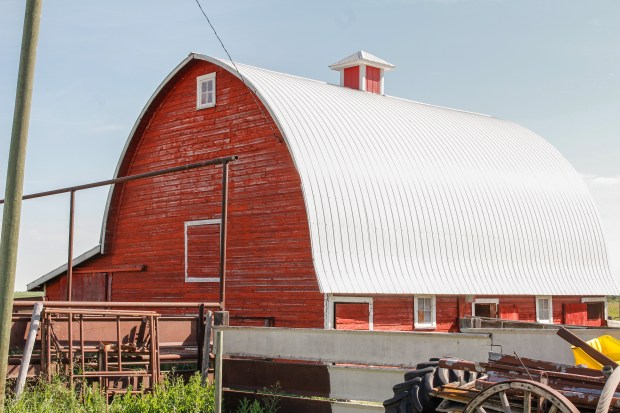
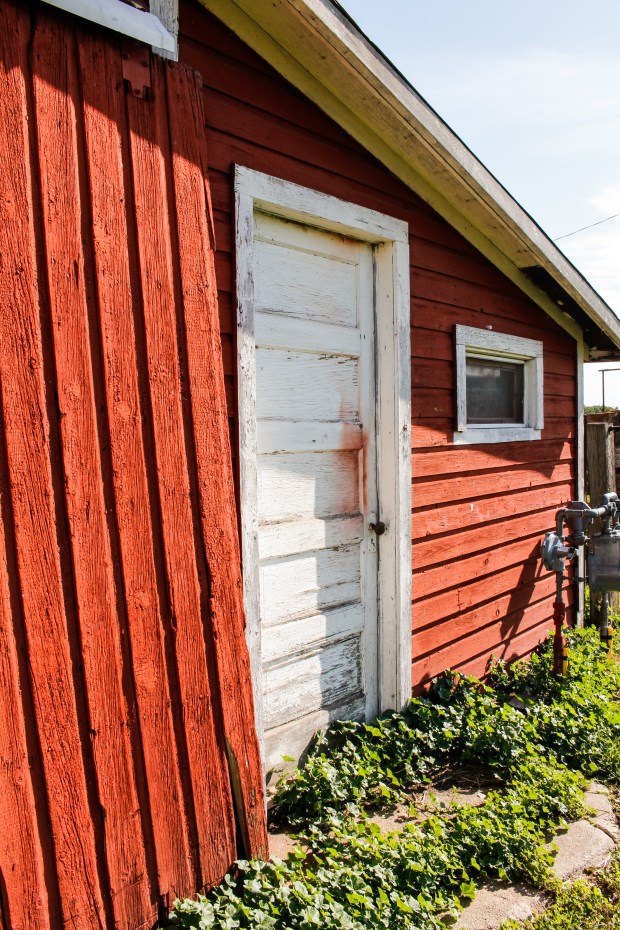
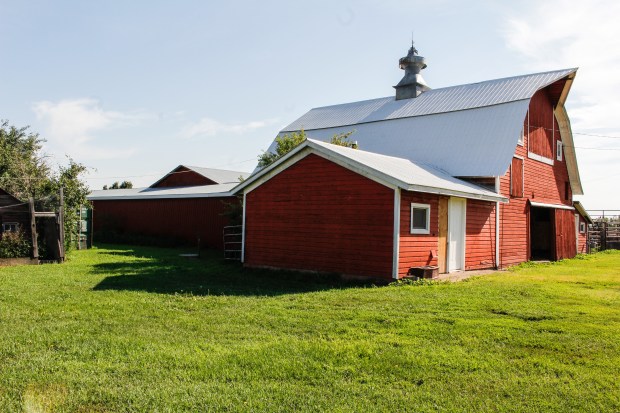
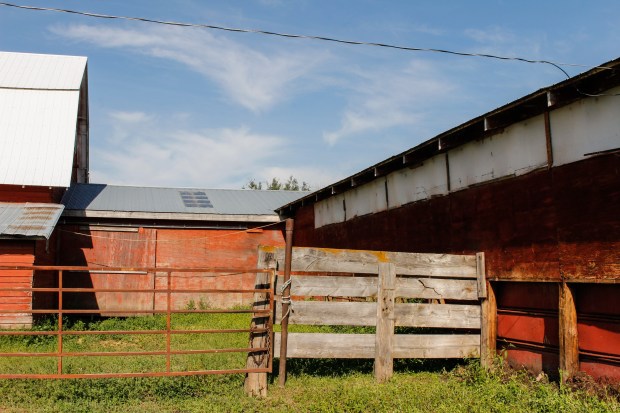
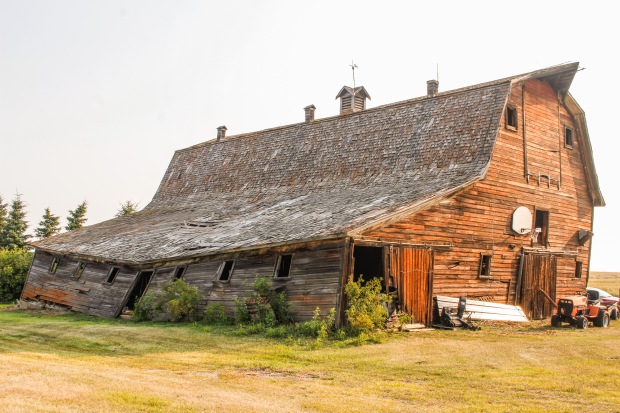
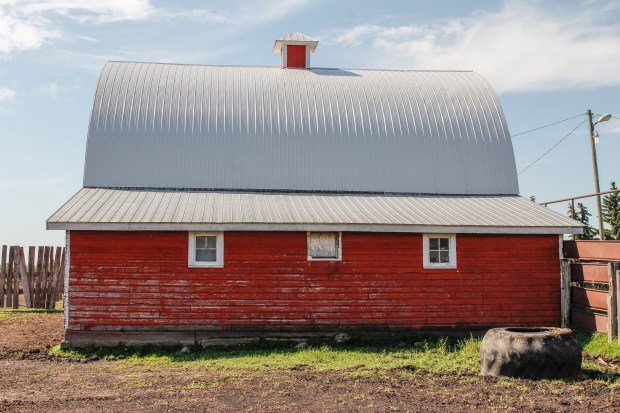
This frame shows the western side of the barn’s roof and the shed addition.
_MG_0748.JPG

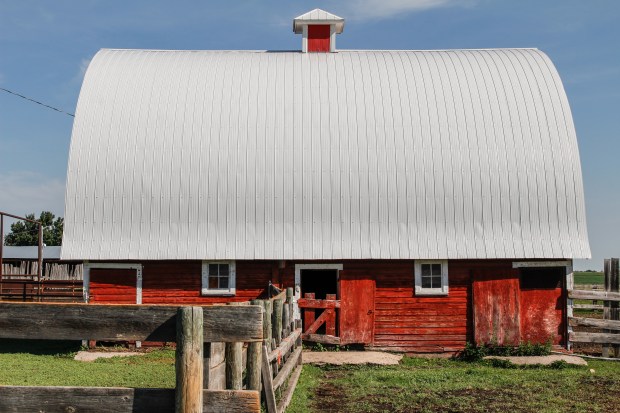
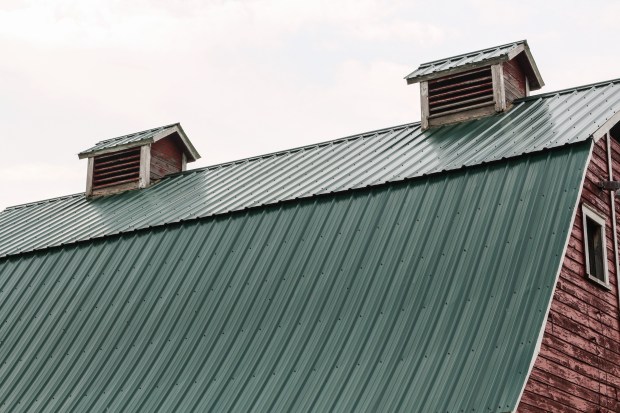
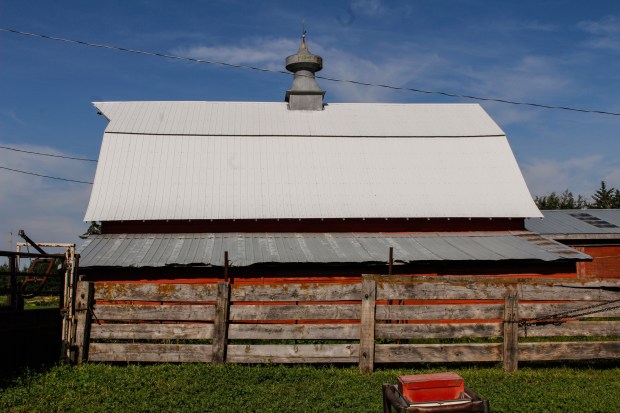
This frame shows the western half of the barn’s roof and the southern face of the barn. Notice how the barn has three small wooden cupolas on the edge of the roof and one large cupola in the center of the barn.
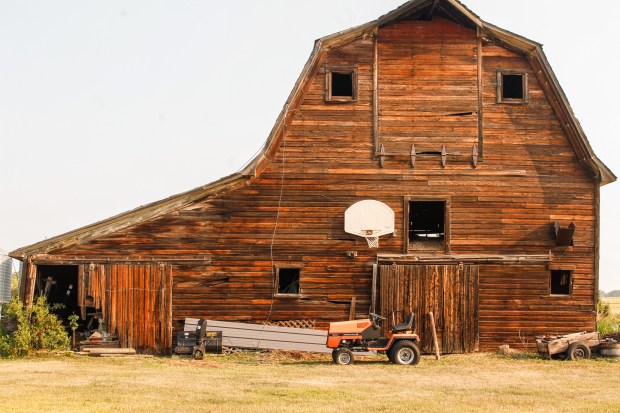
_MG_0751

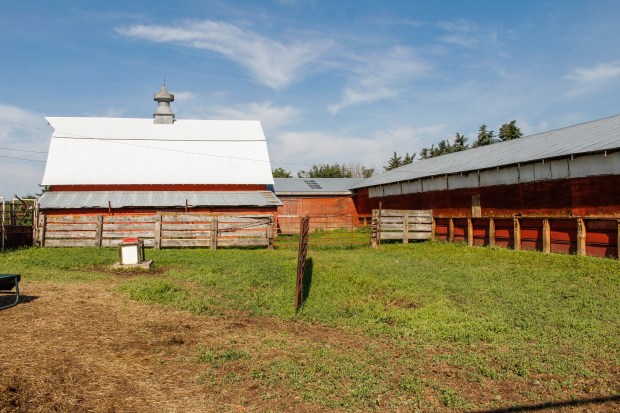
This frame shows the southern face of the barn and shed addition.

_MG_0753

This frame is a close-up of the loft door on the southern face of the barn.
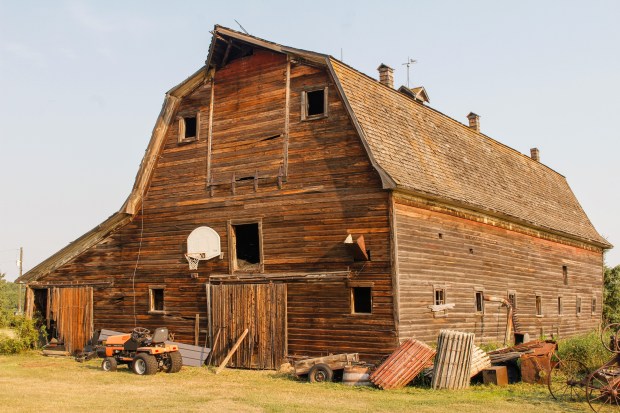
_MG_0762

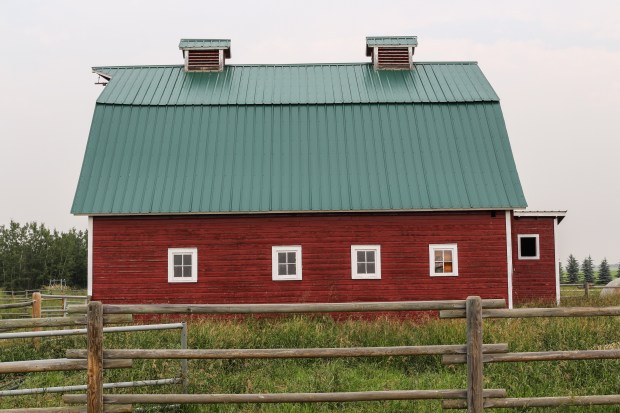
This frame shows the southern face and eastern half of the barn’s roof.

_MG_0769

This frame shows the hay hood and hay track on the southern face of the barn.
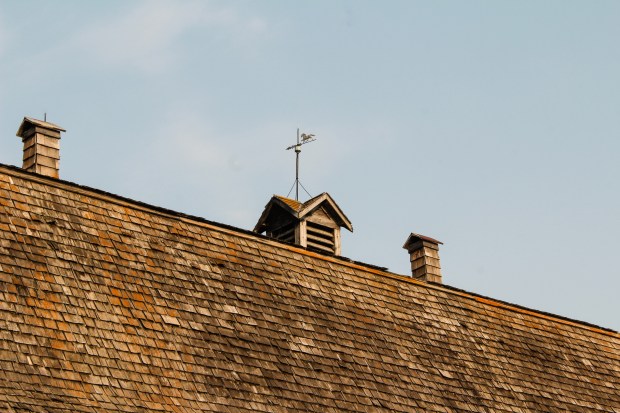
_MG_0766

This frame is a close-up of the center wooden cupola on the barn’s roof.

_MG_0773

This frame shows the eastern side of the barn.
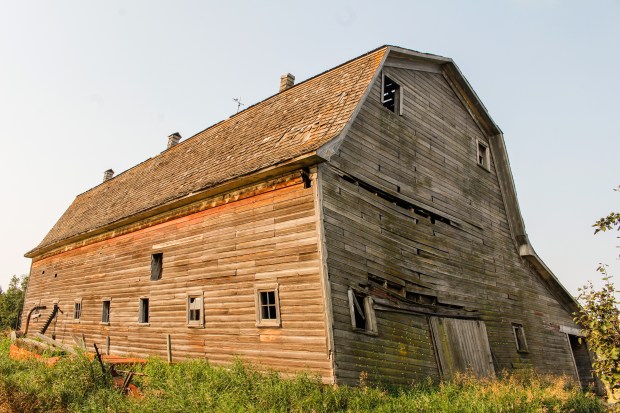
_MG_0776

This frame shows the eastern side and northern face of the barn.

_MG_0780

This frame shows a close-up of the guide for the hay carrier rope in the loft.

_MG_0786

This frame is of the northern face of the barn.
_MG_0790

This frame shows the northern face and part of the western side of the barn.

_MG_0802

This frame shows the north-western corner of the barn’s foundation.
_MG_0799

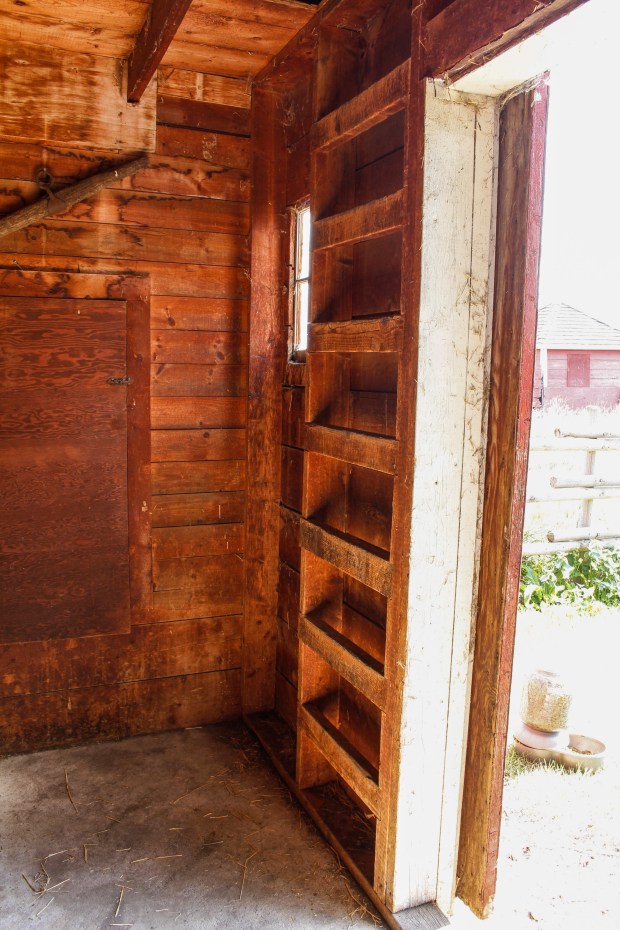
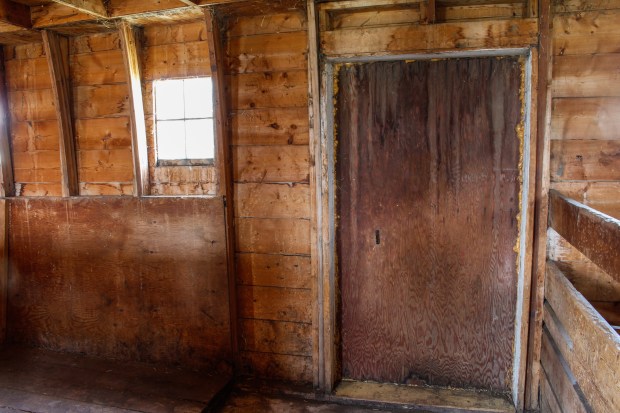
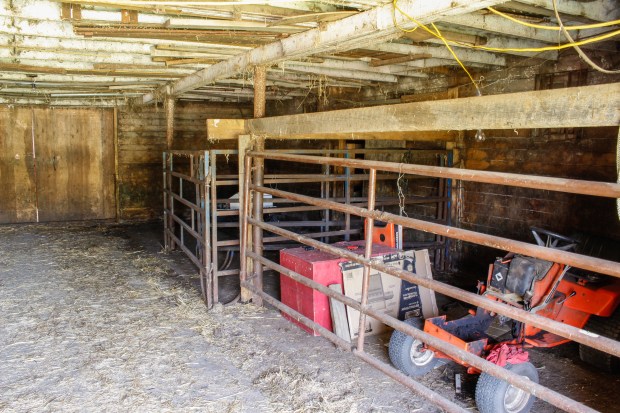
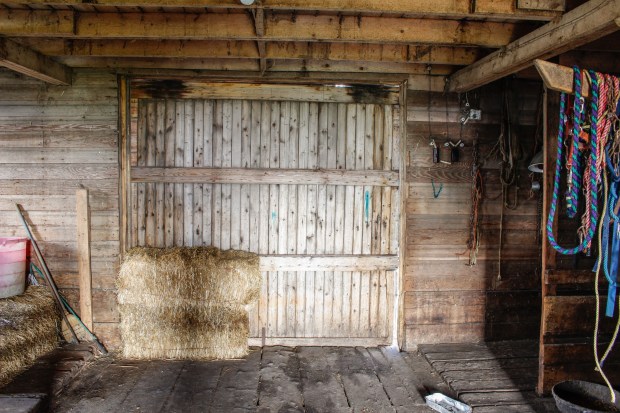
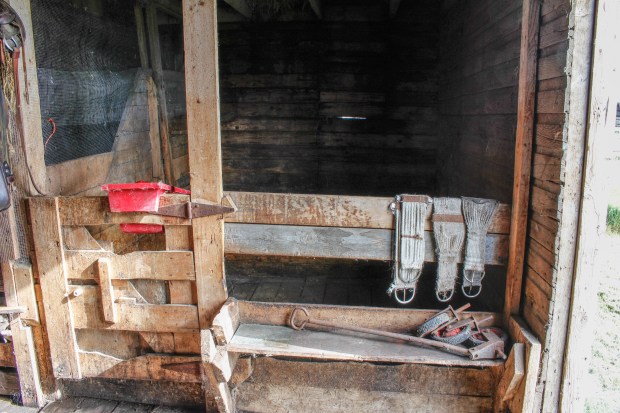
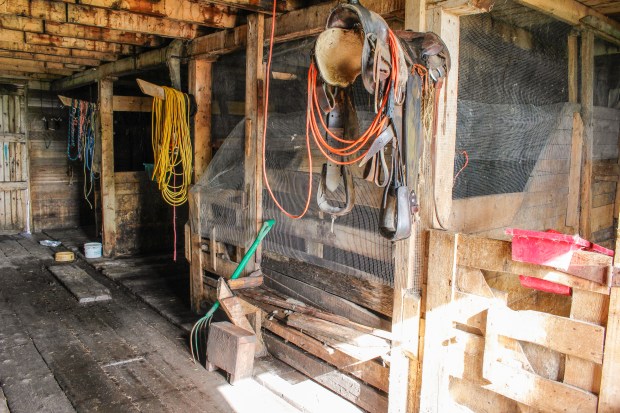
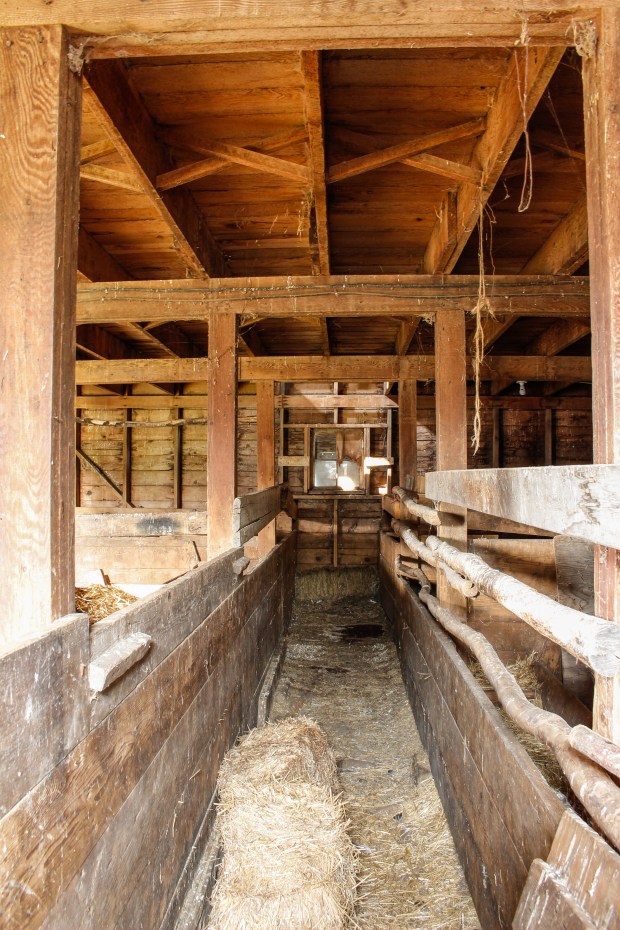
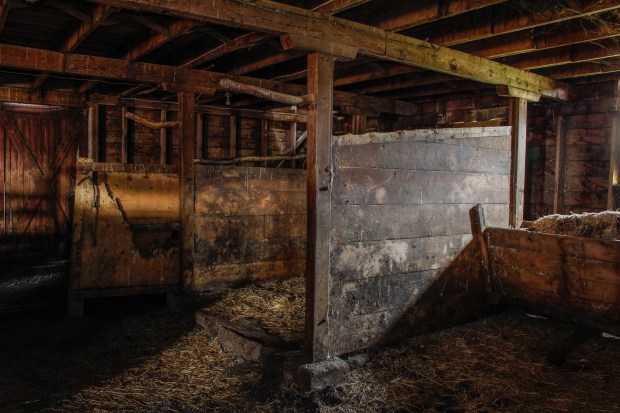
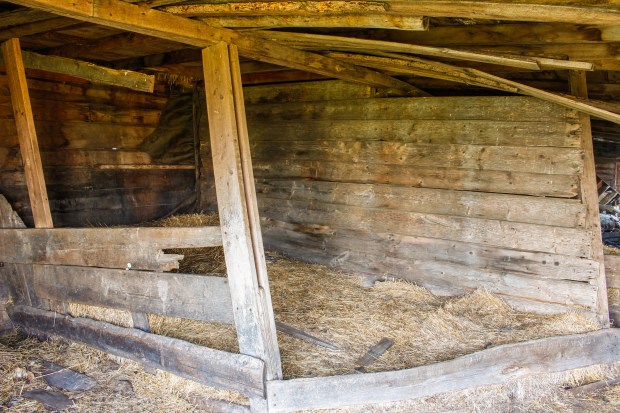
This frame shows the inside of the shed addition on the western side of the barn. This area was used by the Roth family’s horses. The stalls pictured are on the northern end of the barn.

_MG_0800

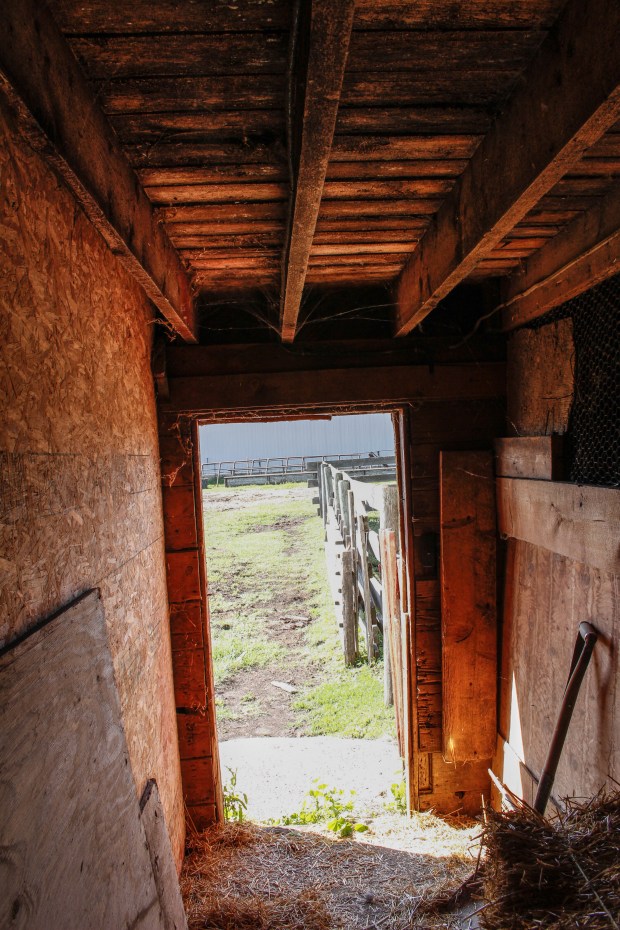
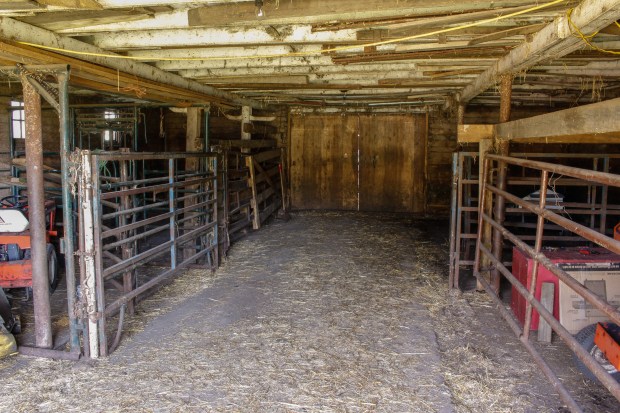
This frame shows the north-south walk-way inside the western shed. This frame was taken from the north whilst looking south.
_MG_0812

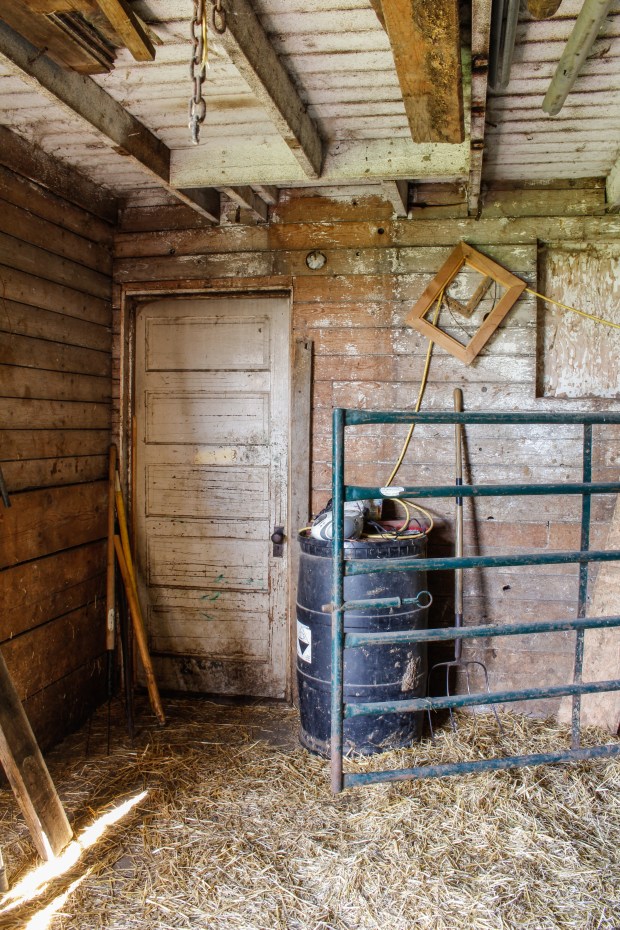
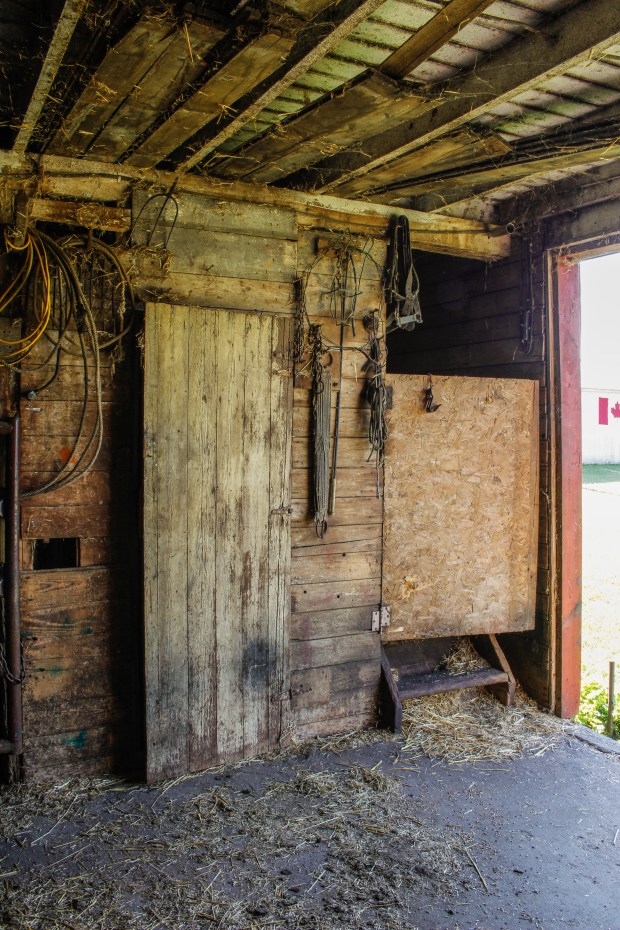
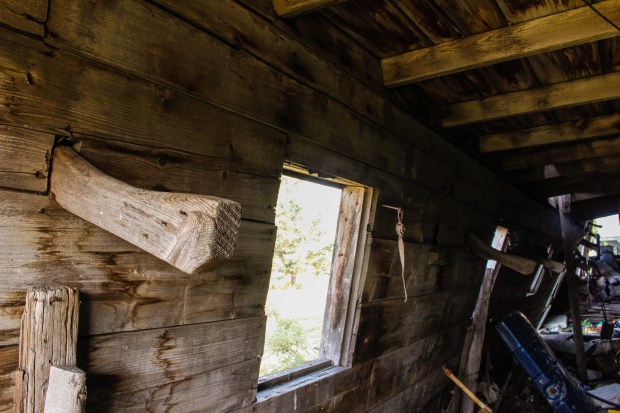
This frame shows the western wall inside the shed. Notice the tack harness in the left aspect of this frame.
_MG_0863

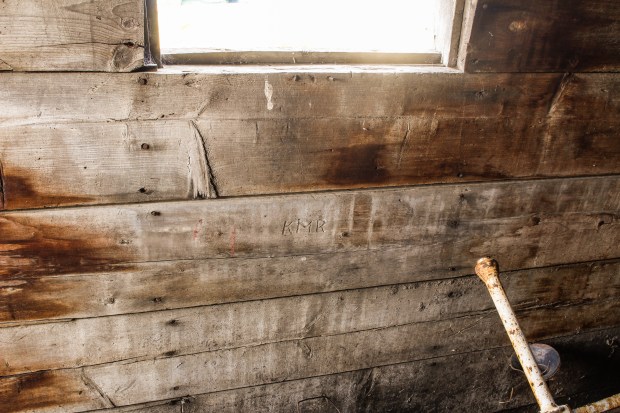
This frame shows the window in the previous frame. Underneath the window are the initials “KMR”. It was carved by Kenneth Michael Roth, Randy Roth’s brother.

_MG_0809

This frame shows the walk-way, part of the roof, and some of the stalls inside the western addition.

_MG_0808

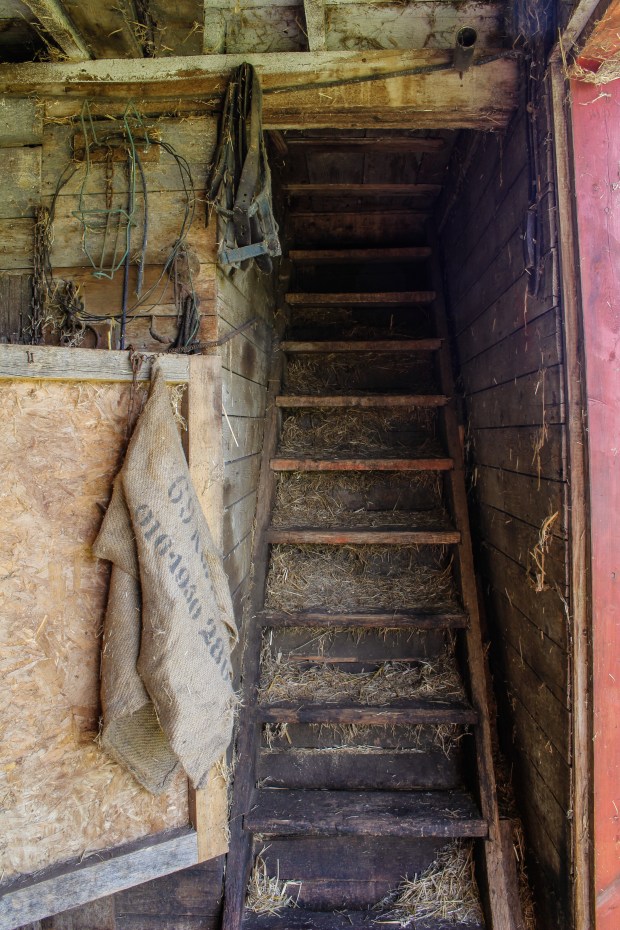
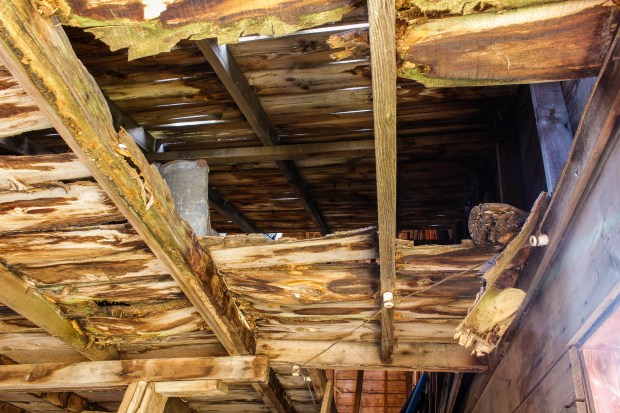
This frame shows the staircase into the barn’s loft. Additionally, there is a door underneath the staircase that leads into the main barn.
_MG_0810

Above the staircase, the floor boards of the loft have rotted away.
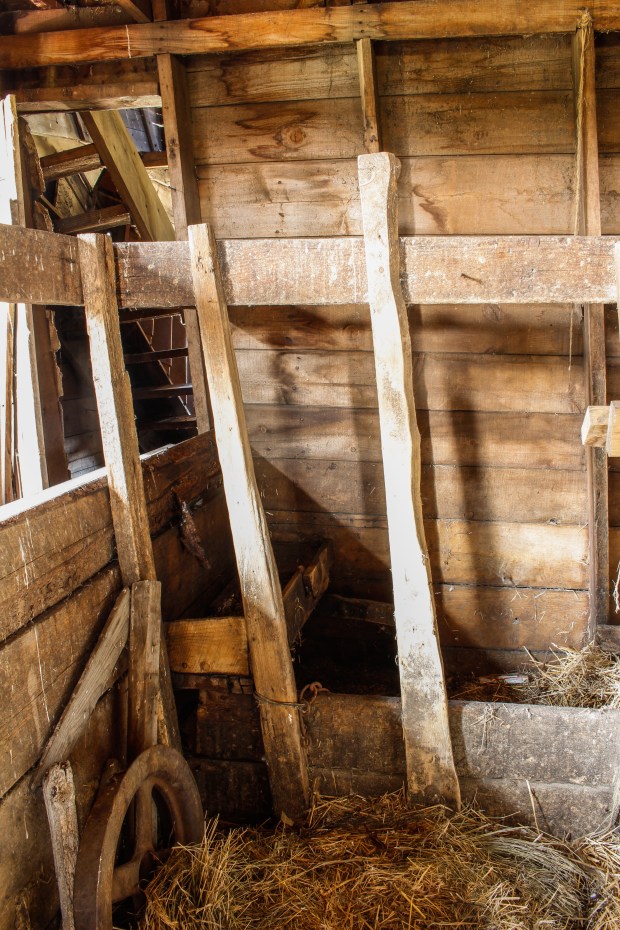
_MG_0814

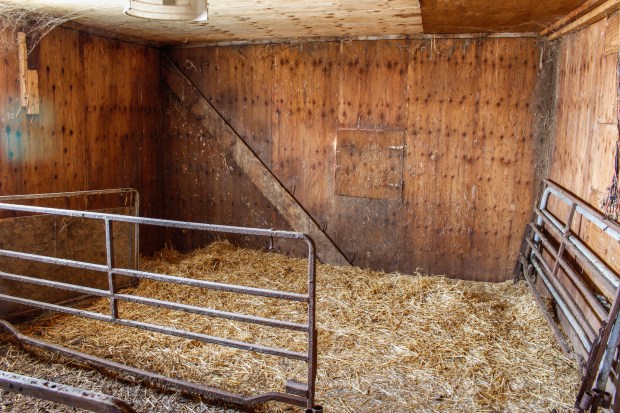
This frame shows one of the stalls inside the main barn. This stall is located in the south-western corner of the barn. The walk-way from the western shed into the main barn is located just out of this frame to the left.
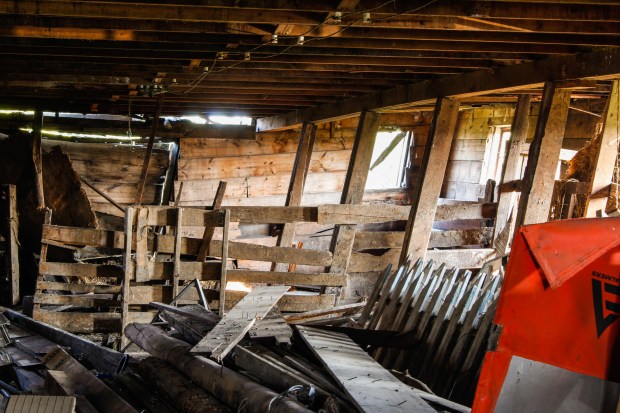
_MG_0818

This frame shows the penned area in the northern end of the main barn. The main barn used to house milk cows and pigs.

_MG_0838

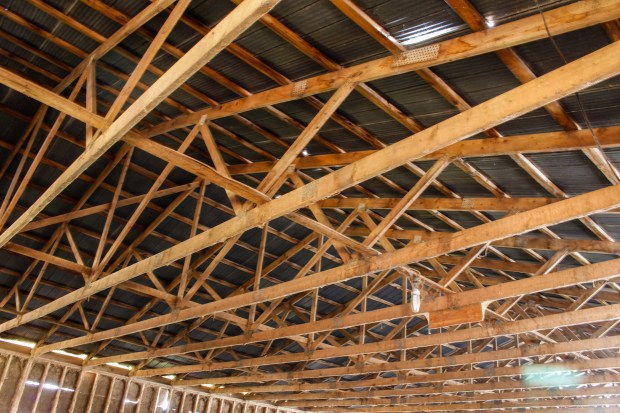
This frame shows the northern face of the barn. Notice the bale elevator and the trusses for the barn’s roof.

_MG_0819

This frame shows the northern face and eastern part of the barn’s roof. Notice the rope for the hay carrier in the right aspect of this frame.
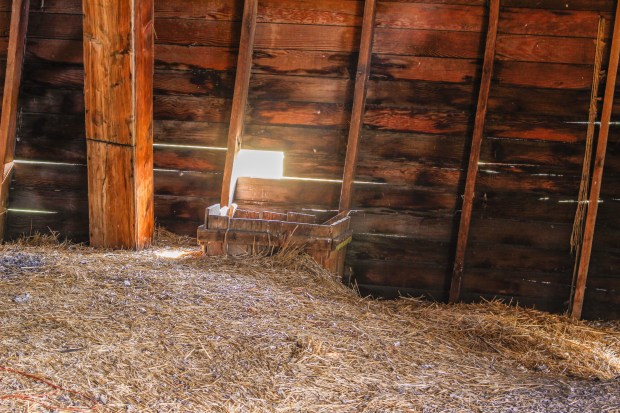
_MG_0848

This frame is a close-up of one of the feed chutes on the western side of the main barn.
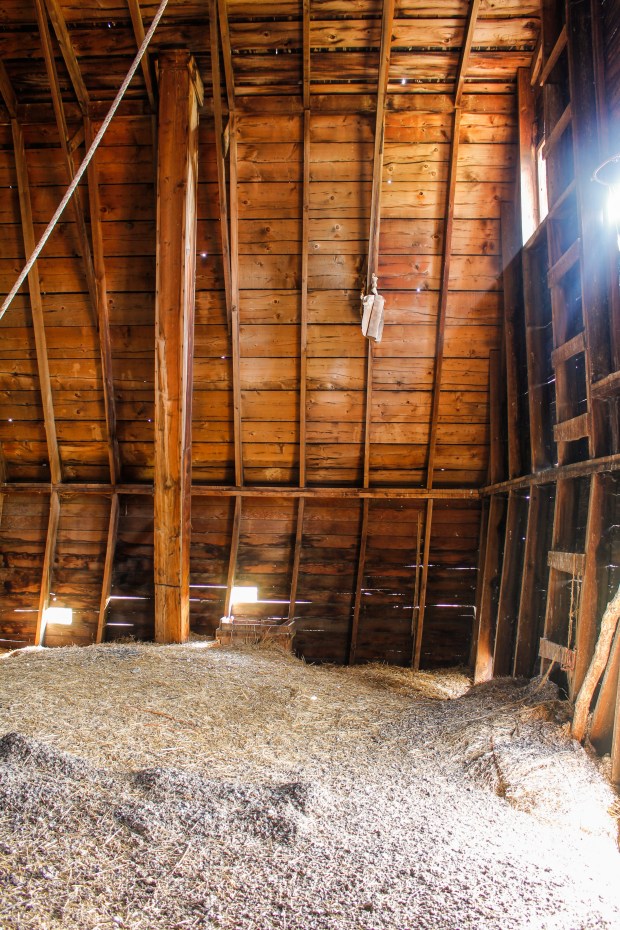
_MG_0825

This frame shows the chute for the smaller cupola in the south-western corner of the barn.

_MG_0831

This frame shows the inside of the loft door on the southern face of the main barn.
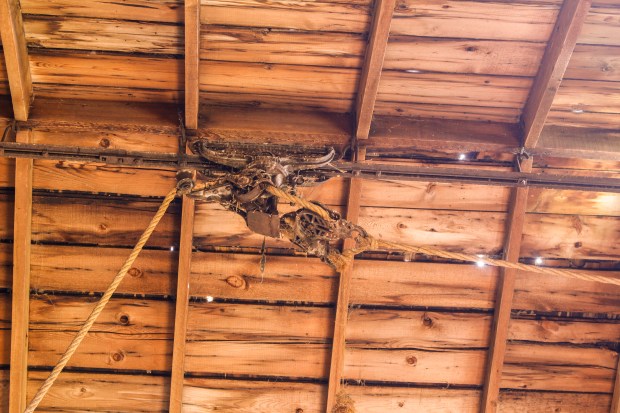
_MG_0828

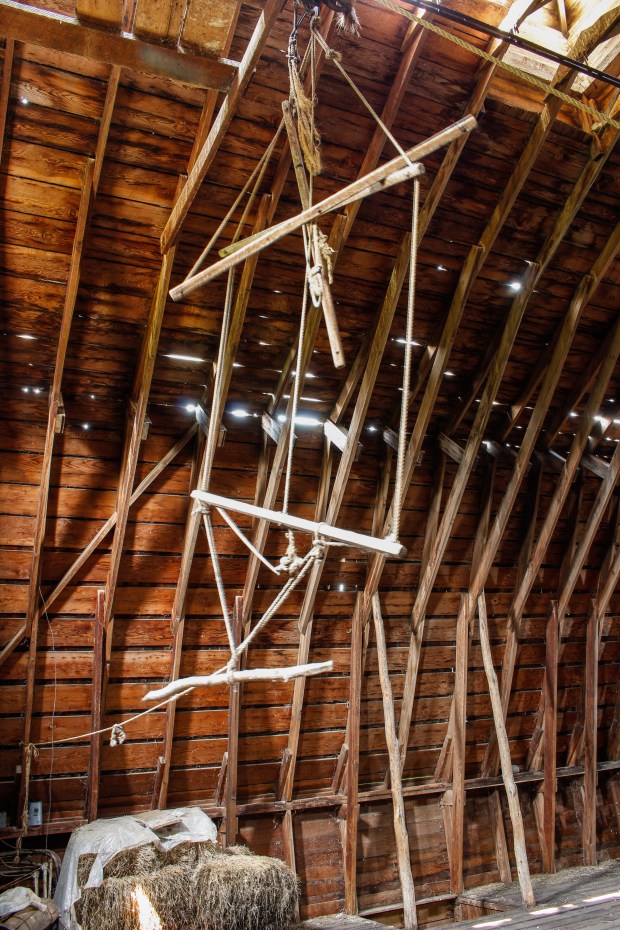
This frame shows the hay carrier in the peak of the barn’s roof.

_MG_0858

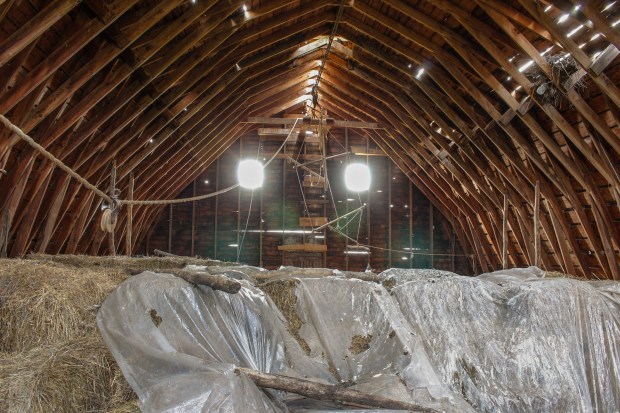
This frame shows the loft above the western shed. Notice the hay chutes in the floor of the loft. These allow hay to be thrown down into the mangers inside the western shed.

Location

52.717520, -112.222832                                       SW 23-43-16 W4

Characteristics

Barn Condition: Poor

Construction Date: 1916

Features: Seven wooden cupolas; one large, six small, hay hood, hay carrier, and hay track, shed addition, weather vane

Roof Shape: Gambrel

Paint: Faded, used to be red with white trim

Decorations: No names or dates

Roof Covering: Wooden shingles

Siding: Wooden drop siding

Foundation: Concrete

Additional History on the Property

Burkhard and Augustine Roth Family History
 

Roth, Herman and Bill. “Roth, Burkhard and Augustine”. Wagon Trails in the Sod: A                         History of Heisler and Area: Volume I. 1st ed. Heisler: Heisler Historical                               Society, 1982. Print.

William (Bill) and Mary Roth Family History
The Family. “Roth, William and Mary”. Wagon Trails in the Sod: A History of Heisler and                    Area: Volume I. 1st ed. Heisler: Heisler Historical Society, 1982. Print.

Randy and Barb Roth Family History
“Roth, Randy and Barb”. Wagon Trails in the Sod: A History of Heisler and Area: Volume                    II. 1st ed. Heisler: Heisler Historical Society, 1982. Print.

Badry

History

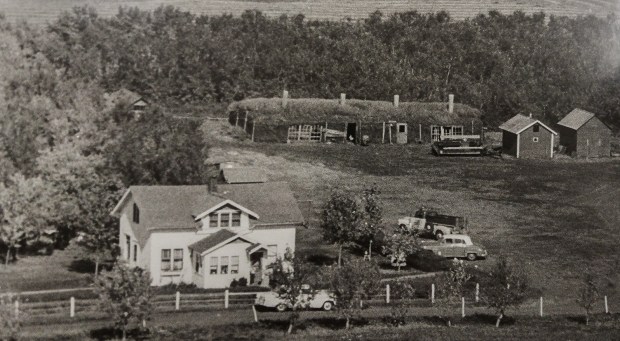
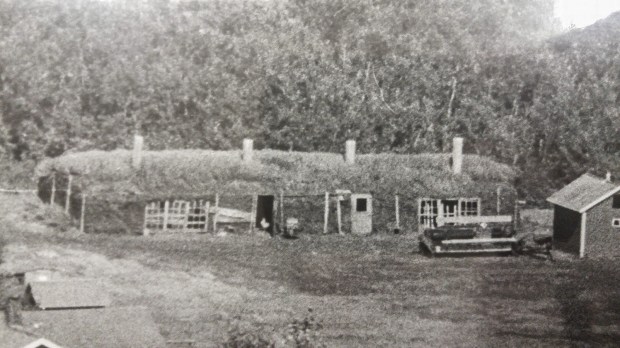
There were 2 identical chicken barns and a milk barn built from sod by William and Frank Badry in about 1928 on the SW 31-42-15 W4. The following description is for the two sod chicken barns. The walls of both chicken barns were made of sod, specifically dried slough bottoms that were cut with a plough by horse. The sod pieces were about 16 inches wide and were laid next to each other to create 2 feet thick walls. The roofs of the barns were created using a layer of branches, leaves, and straw with six to eight inches of black soil on top. The roof had a slight arched shape to it because of the materials used and the fact that the support posts in the center of the barn were all a few inches taller than the sod walls. The floors of the barns were concrete. The windows faced to the south on both barns to let light in as there was no power in the barns originally. Power was installed in the barns in about 1950. Four ventilators were built into each barn. Each ventilator was square, created using planed lumber, and ran from the ground up through the peak of the barn’s roof. There was a partition wall in the center of the barn which created two separate rooms in each barn. William and Frank Badry made water troughs out of metal bins and wooden boards, roosts out of logs, and nest boxes out of lumber to furnish the barn. Both barns were approximately 30 ft. x 60 ft. x 20 ft. when they were built. While these two barns are not longer standing, they are very unique due to their construction method. Many sod buildings have not been able to stand the test of time, especially if they were well-used.

Frank Badry came to the Heisler area in 1919. He married Mary Tarnowski on October 22, 1922. The couple rented various homesteads in the area before purchasing the land this barn sits on in 1932. They lived there until 1965 when they moved into Camrose. Their son, Victor, and his wife, Maxine, began living on this property in 1959 in a separate house in the south-eastern part of the yard. Due to each barn’s proximity to their homes, Frank and Mary kept their chickens in the northern barn and Victor and Maxine kept their chickens in the southern barn. The chicks were first kept in the brooder house and then moved to the sod barns. There were approximately 250 chickens kept in each half of the barn.

By the time Victor and Maxine Badry moved out to the farm, the north chicken barn had partially collapsed. The damaged portion, the eastern end of the northern barn, was removed and replaced with chicken wire to create an outdoor pen. The remainder of the northern barn stood until 1975. The southern barn collapsed in June of 1970 after several inches of rain. The collapsed roof trapped the chickens. Some chickens were saved by digging through the sod but several hundred died. It was a terrible incident for the family. Victor and Maxine lived on the property until about 1991 when they moved into Heisler.

Beginning in 1984, Shawn Badry, Victor and Maxine’s son, began milking his own cows on the family farm. He also helped with his father’s farming operation, milking cows and doing chores. He, his wife, Janice, have lived on the property since October 1991.

Badry, Maxine. Personal communication. 17 Aug. 2017.

Badry, Roger. Personal communication. 17 Aug. 2017.

“Badry, Shawn and Janice”. Wagon Trails in the Sod: A History of Heisler and Area:                    Volume II. 1st ed. Heisler: Heisler Historical Society, 2017, pg. 227-278. Print.

Badry Homestead 1956

Badry homestead in 1956.

Badry Sod Barn 1

Close-up of the northern chicken barn. The eastern end, right side of the pictured barn, was partially collapsed by the time Victor and Marion moved to the farm. The windows on the barns face south to let light in.

Badry Sod Barn 1956

Northern chicken sod barn in 1956. The two men in the picture are most likely Willam and Frank Badry.

Location

Northern Barn: 52.659305, -112.161298                         SW 31-42-15 W4

Southern Barn: 52.658073, -112.160714                         SW 31-42-15 W4

Characteristics

Barn Condition: Destroyed

Construction Date: 1928

Features: Four ventilators on each barn

Roof Shape: Slightly arched

Paint: None

Decorations: No names or dates

Roof Covering: Branches, straw, and sod

Siding: None, sod walls

Foundation: Cement

Additional History on the Property

Frank and Mary Badry Family History

Badry, Maxine. “Badry, Frank, Mary and Family”. Wagon Trails in the Sod: A History of             Heisler and Area: Volume I. 1st ed. Heisler: Heisler Historical Society, 1982. Print.
Victor and Maxine Badry Family History

Badry, Maxine. “Badry, Victor and Maxine”. Wagon Trails in the Sod: A History of Heisler       and Area: Volume II. 1st ed. Heisler: Heisler Historical Society, 2017. Print.

Shawn and Janice Badry Family History

“Badry, Shawn and Janice”. Wagon Trails in the Sod: A History of Heisler and Area:                    Volume II. 1st ed. Heisler: Heisler Historical Society, 2017. Print.

Moser

History

This barn was built in 1968, after a fire destroyed the original barn on the property on September 18th, 1967. It is the smallest barn in this database and was built using more modern methods. The arched ribbed roof and high-grade concrete foundation are some of the last innovations in barn building.

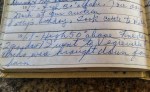
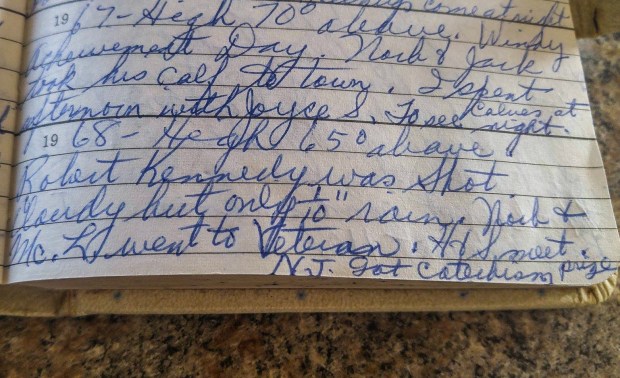
Norbert (Norb) and Esther Moser were married November 23, 1942 and bought the property this barn sits on in 1943. Esther Moser kept a diary, which she wrote in everyday. She recorded the fire that destroyed the family’s original barn and the delivery of parts for the new barn. Photos of these entries can be seen at the bottom of this page.

It is believed that this barn was built by the Taralson family as they had a building business in Killam at the time. The barn was built using frame construction and balloon framing. The arched ribs for the roof of the barn run from the foundation to the peak. The current barn on the property has only been used to store square bales because it was built after the loose-hay era. The current barn does not have a hay track, hay carrier, or hay hood.

Norb and Esther always had cattle while they lived on this property. They used their barns for cattle and 4-H calves. Additionally, they also had riding horses that they would sometimes keep or saddle within the barn. In 1972, Norb and Esther moved into Killam and their son, Jack, moved to this property.

In June of 1977 Jack Moser married Sharon Graham. The pair raised their four boys on the family farm; Jamie, Christopher, Adam, and Justin. Throughout the years, Jack and Sharon have used the current barn on their property for horses, calves, baby chicks in the spring, and “Shamrock” – the milk cow.  Many a barn cat have made the barn their home. As well, the four Moser boys and their friends were often found playing in the loft of the barn.

It is believed that the original barn on this property burnt down due to spontaneous ignition. On September 18th, 1967, the Moser family finished filling the loft of their original barn with fresh hay. It was a hot day and it is believed that the hay in loft got to a high enough temperature that it ignited. Luckily, there were no animals inside the barn at the time. However, the barn and most of its contents could not be saved. Jack Moser remembers running home from the neighbours house to see his father, Norb, trying to save their horses’ tack. Norb was able to save a few items before he was unable to reenter the barn.

Moser, Jack and Sharon. Personal communication. 15 Aug. 2017.

_MG_0680

This frame shows the southern face of the barn.

_MG_0682

This frame shows the southern face and the eastern side of the barn.

_MG_0685

This frame shows the eastern half of the barn’s roof.

_MG_0687

This frame shows the eastern side and the northern face of the barn.

_MG_0690

This frame shows the northern face of the barn.

_MG_0695

This frame shows the western half of the barn’s roof.

_MG_0696

This frame shows a close-up of the weather vane on the barn’s roof.

_MG_0707

This frame shows the southern half of the western wall. This frame was taken whilst standing in the doorway on the southern end of the barn. Notice the stands for saddles on the western wall.

_MG_0703

This frame shows the chop bin in the south-eastern corner of the barn.

_MG_0704

This frame shows the ladder up into the loft on the southern end of the barn. The doorway in the right aspect of this frame is the door in the southern face of the barn.

_MG_0710

This frame shows the inside of the western door of the barn.

_MG_0714

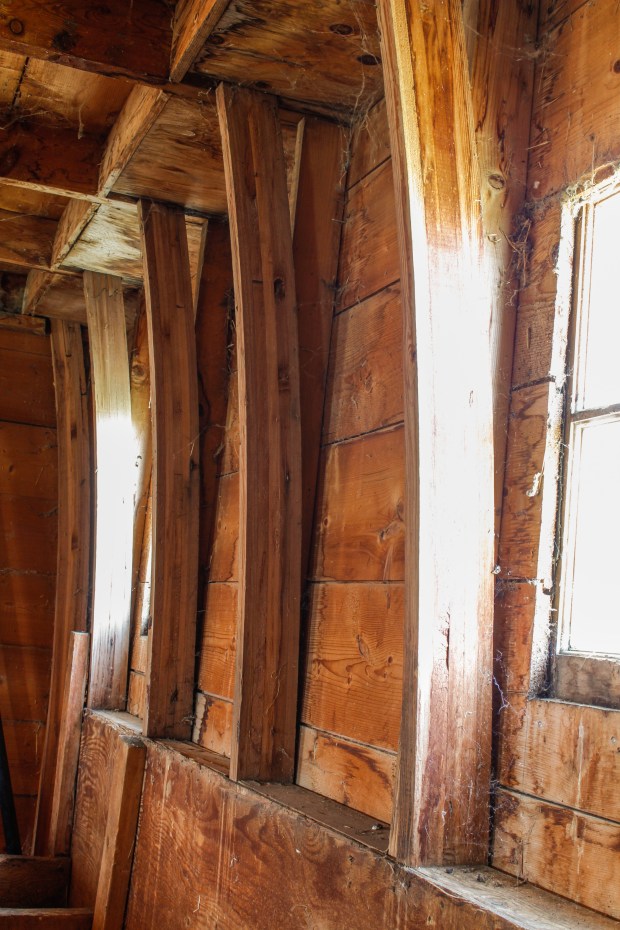
This frame shows the western wall of the barn. Notice the arched ribs for the barn’s roof in the center of the frame.

_MG_0711

This frame shows the horse stall on the western side of the barn.

_MG_0734

This frame shows the walkway through the barn as taken from the western side of the barn.

_MG_0727

This frame shows the walkway through the barn as taken from the eastern side of the barn.

_MG_0719

This frame shows the horse stall on the eastern side of the barn.

_MG_0722

This frame shows the eastern pen in the northern end of the barn. Notice the cement floor in the pen.

_MG_0725

Both the north-eastern and the north-western pens have angled mangers like this.

_MG_0735

This frame shows the inside of the barn’s loft. The background shows the northern face of the barn.

_MG_0738

This frame shows the arched ribs for the roof. The ribs angle greater within the loft than on the main floor.

_MG_0745

This frame shows some of the bales that are stored in the loft of the barn. This barn was never used to store loose hay.

Moser Homestead 1954

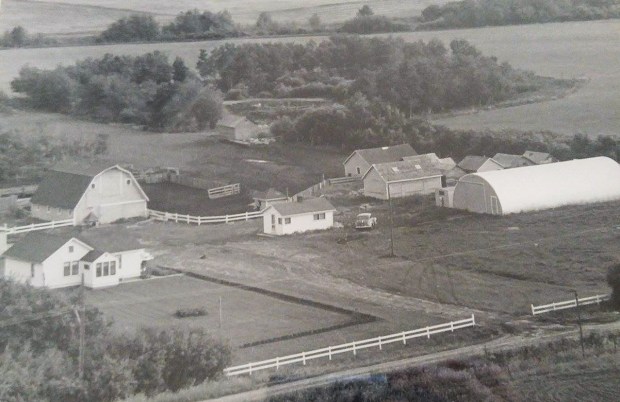
Aerial photo of the Moser homestead in 1956. The barn in the left aspect of the frame is the original barn on the property.

Location

52.815114, -111.908982                                       SW 25-44-14 W4

Characteristics

Barn Condition: Good

Construction Date: 1968

Features: Weather vane on southern edge of roof

Roof Shape: Arched

Paint: Red with white trim

Decorations: No names or dates

Roof Covering: Metal

Siding: Wooden drop siding

Foundation: Cement

Additional History on the Property

Esther Moser’s 5-Year Diary

Esther Moser kept a diary everyday for the majority of her life. She recorded everything from the temperature that day to the duties she completed around her home. She wrote about a few interesting events involving the barn in 1967 and 1968. The following entries are from September 18th, 1967, March 20th, 1968, and March 22nd, 1968.

Esther Moser also recorded a line on June 5th, 1968 that might be of interest to some readers. It can be seen below.

Esther Moser Diary June 5, 1968

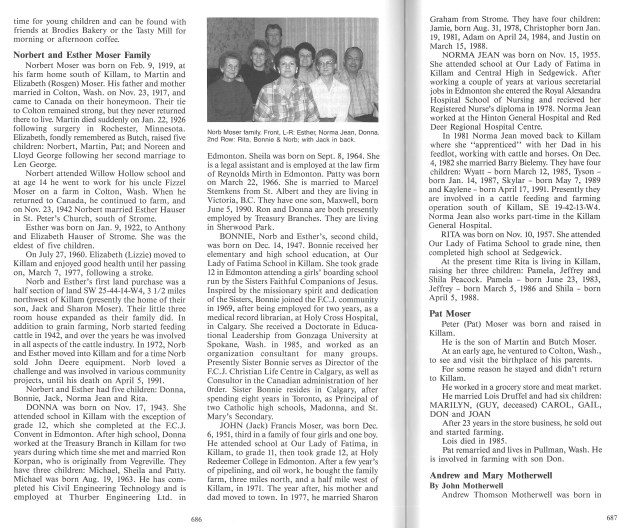
Norbert (Norb) and Esther Moser Family History

Moser Family History 1

“Norbert and Esther Moser Family History”. The Pleasant Country: Volume Two Killam                         and District 1903-1993. 1st ed. Killam: Killam Historical Society, 1993. Print.

Gale-Morel

History

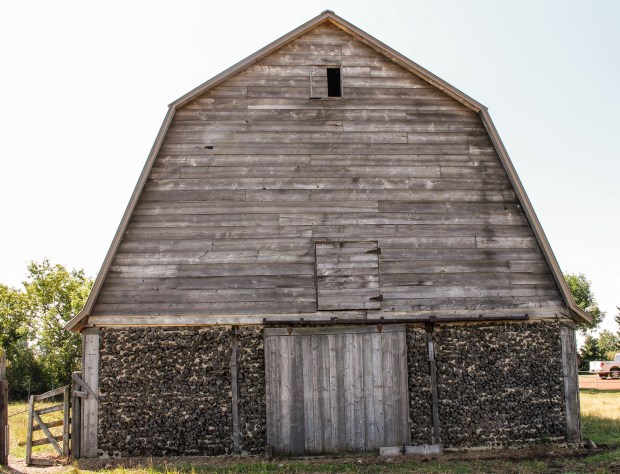
This barn is believed to have been built in the 1930s by Byron Gale with the help of his family and neighbours. Ed Gale, Byron’s father, came to the area in 1917 from St. Thomas, Ontario. Byron served in World War II and bought the farm from Ed when he came back home after the war.

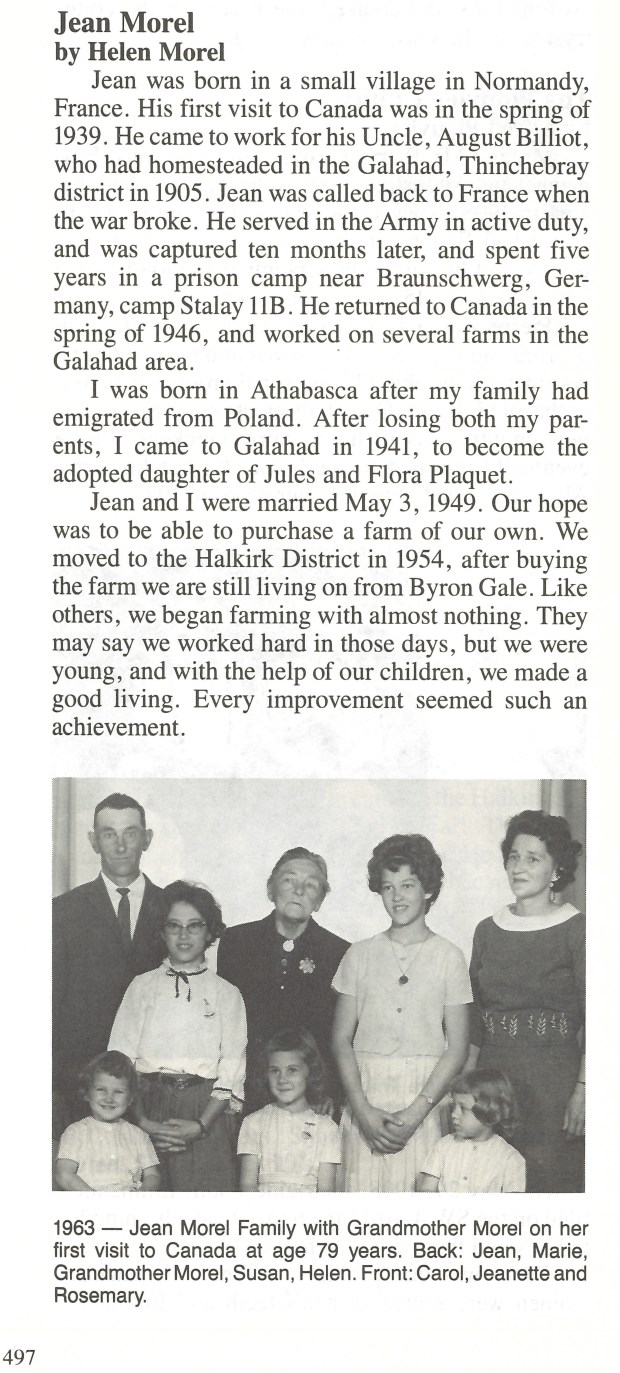
Jean and Helen Morel moved to the property this barn sits on in 1952. They acquired the land under the Veterans Land Act as Jean had served in the Second World War. Jean had been living in the Galahad area with his uncle, August Billiot, before he was called back to France at the beginning of the war and decided to come back to the area after the war. He met Helen while returning an incorrectly mailed letter while still in the Galahad region. They moved to this property after their marriage in 1949.

Jean and Helen used the barn for milk cows in the early days. Five milk cows were enough to keep them afloat. Helen remembers that they would receive the cream cheque and most of it would be gone by Monday to pay the expenses. However, after the family purchased some piglets with loan money from a friend, they found life much more stable. In recent years, the barn has been used for storage or left vacant.

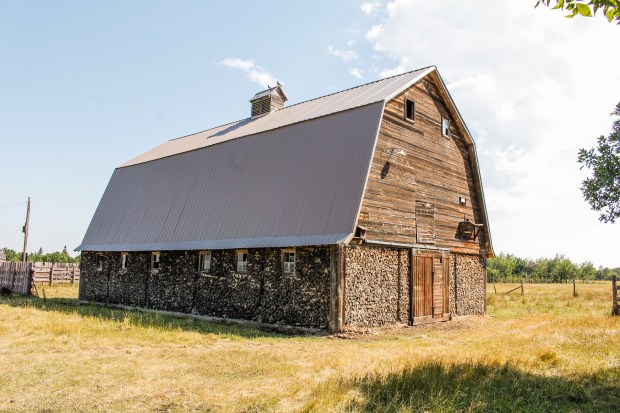
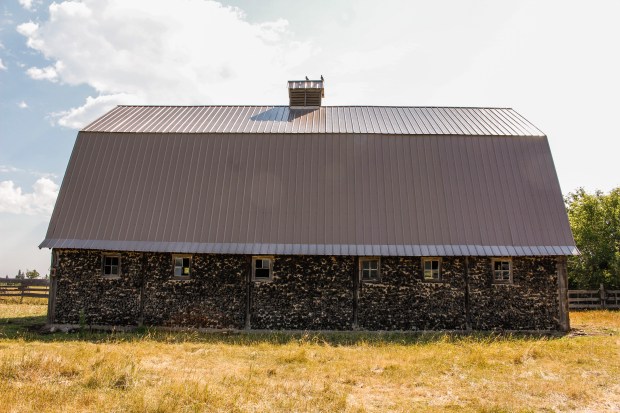
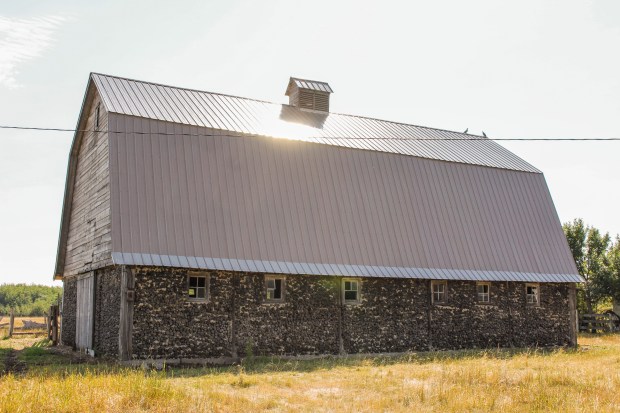
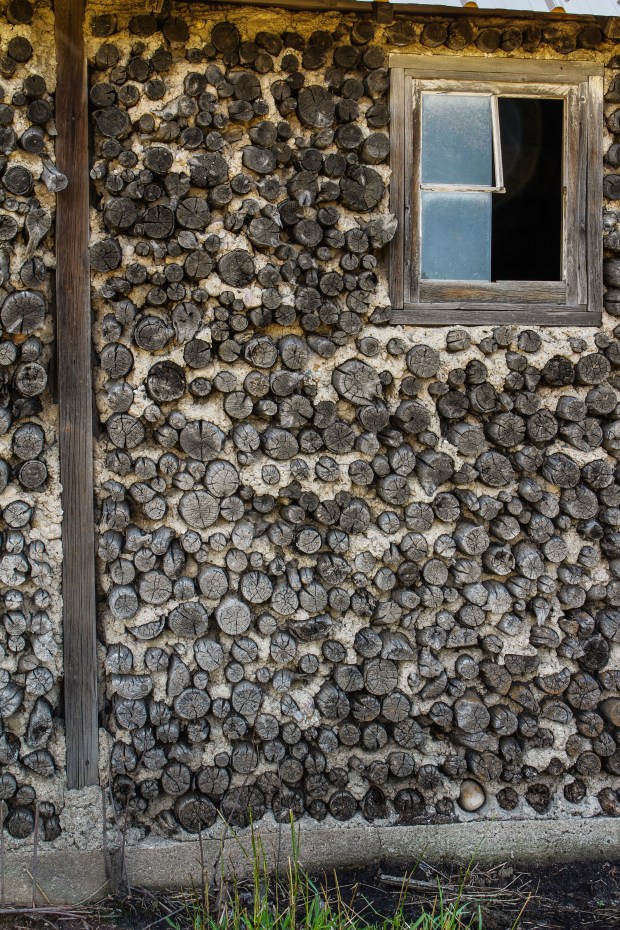
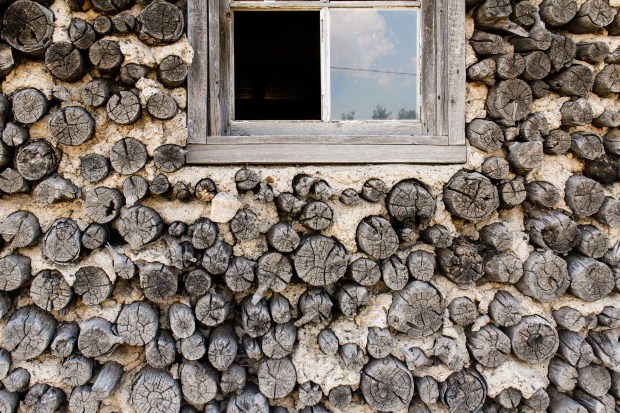
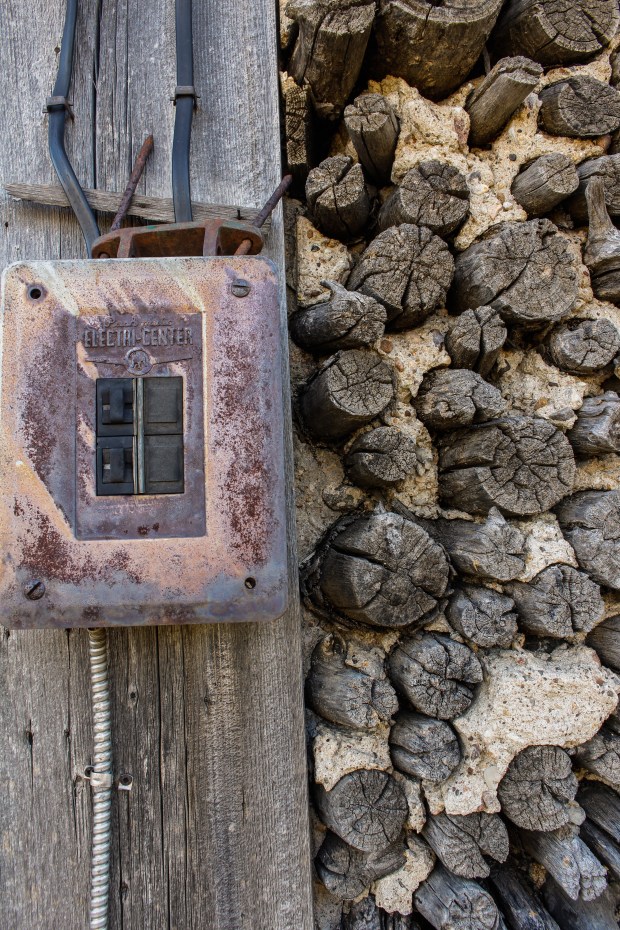
The barn is very unique because the ground floor walls are cordwood construction. From the outside, this can look like field stone construction but it is actually debarked trees laid perpendicular to the wall’s direction and bound together with mortar. This method makes for a very durable building.

Morel, Helen. Personal communication. 28 Jul. 2017.

_MG_9569

This frame shows the southern face of the barn and the western half of the barn’s roof.

_MG_9573

This frame shows the western side of the barn. Notice the single cupola in the middle of the barn.

_MG_9580

This frame shows the western side of the barn and part of the northern face of the barn.

_MG_9587

This frame is a close-up of one of the outer walls for the western set of stalls. Notice the post in the left aspect of this frame. The post supports the beams on the barn’s loft.

_MG_9581

This frame is a close-up of the cordwood walls that makeup the barn.

_MG_9589

This frame shows an electrical box on the exterior of the north-western corner of the barn.

_MG_9590

This frame shows the northern face of the barn.

_MG_9593

This frame is a close-up of the sliding door on the northern face of the barn.

_MG_9595

This frame is a close-up of the gate near the northern face of the barn.

_MG_9601

This frame shows the northern face of the barn and part of the eastern half of the barn’s roof.

_MG_9604

This frame shows the eastern half of the barn’s roof.

_MG_9607

This frame shows the eastern half of the barn’s roof and part of the southern face of the barn.

_MG_9643

This frame shows the southern face of the barn. Notice how there is no hay hood or hay track in this barn.

_MG_9613

This frame is a close-up of the sliding door on the southern face of the barn. Notice how the sliding door has a smaller door built into it.

_MG_9614

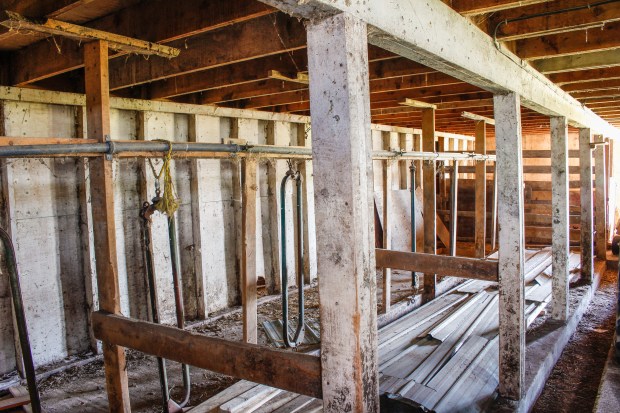
This frame shows the south-eastern stall inside the barn.

_MG_9619

This frame shows the north-eastern penned area inside the barn.

_MG_9624

This frame shows the north-western corner of the barn. Notice how the cordwood walls look from the inside of the barn.

_MG_9625

This frame shows the western penned area in the northern half of the barn.

_MG_9630

This frame shows the western stalls in the southern half of the barn.

_MG_9618

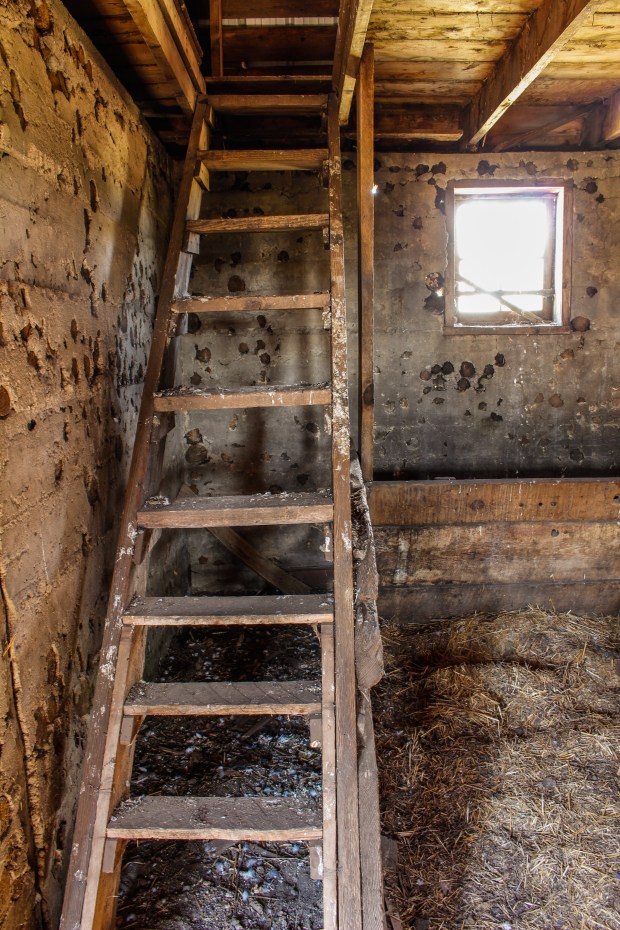
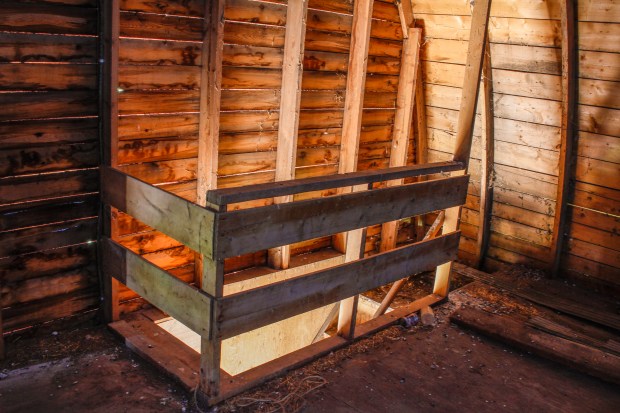
This frame is a close-up of the staircase to the barn’s loft.

_MG_9636

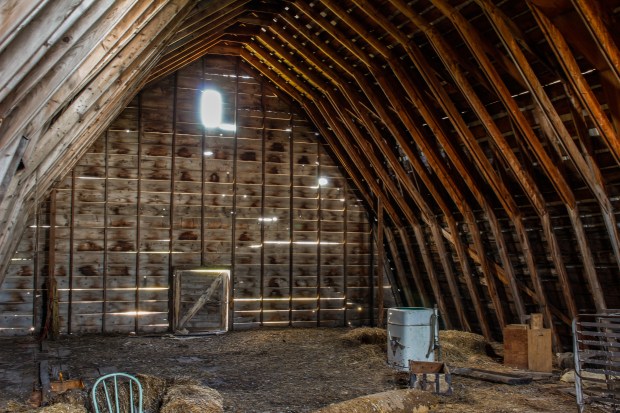
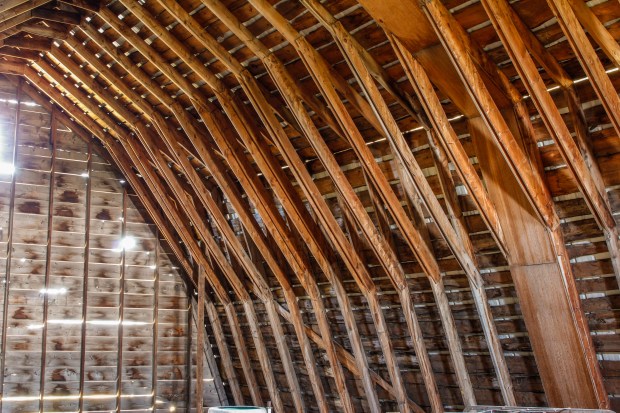
This frame shows the trusses which make-up the western half of the barn’s roof.

_MG_9631

This frame shows the northern face of the barn.

_MG_9640

This frame shows the eastern half of the barn’s roof.

Location

52.347180, -112.041897                                       SW 13-39-15 W4

Characteristics

Barn Condition: Fair

Construction Date: Believed 1930s

Features: Single cupola

Roof Shape: Gambrel

Paint: None

Decorations: No names or dates

Roof Covering: Metal

Siding: Cordwood

Foundation: Cordwood and cement

Additional History on the Property

Gale Family History

Gale, B., Murray, A., & O’Neill, B. “Mr. and Mrs. Edwin Gale”. Halkirk Home Fires and                      Area. 1st ed. Halkirk: Halkirk Historical Society, 1985. Print.

Morel Family History

Morel Family History.jpg

Morel, Helen. “Jean Morel”. Halkirk Home Fires and Area. 1st ed. Halkirk: Halkirk                              Historical Society, 1985. Print.

Brausen-Kroetsch

History

This barn was built in the summer of 1970. The original barn, built by Joe and Carrie Brausen, Glen Brausen’s parents, burned to the ground in May of 1970. The milking machine, cream separator, and other items were lost, but only one cow, a calf, and some pigs perished. During construction of the barn, the cows were milked outside, often in pouring rain.

This arch rib barn originally had drop siding, cedar shingles, and a small sliding hay door on each end of the hay loft. A lean-to addition was built on the eastern side of the barn to house pigs and calves. Herman Roth was the main carpenter with many friends and neighbours helping out. When construction was completed, a barn dance was held in the loft as a sign of appreciation for all the help from those friends and neighbours.

Glen and Germaine Brausen, sons of Joe and Carrie, continued to milk cows in this new barn and ship cream. Later the barn was used for calving beef cows. Glen continued to raise pigs in the lean-to, mostly for the annual family hog butchering. As many as 13 pigs were butchered one year.

Glen and Germaine’s sons especially enjoyed playing in the barn; even daring one of their brothers to jump out of the hayloft. It only winded him, but his brothers thought he was dead. Instead of rushing to his aid, a lengthy discussion ensued about how much trouble they were going to be in!

In the mid 90’s, the barn roof was tinned, and the barn painted. Colin and Barb purchased the land after the passing of Barb’s dad, Glen. Presently the barn is used for storage.

Kroetsch, Colin and Barb. Personal communication. 27 Jul. 2017.

Kroetsch, Colin and Barb. Wagon Trails in the Sod: A History of the Heisler Area: Volume           II. 1st ed. Heisler: Heisler Community Historical Society, 2017, pg. 644. Print.

_MG_9536

This frame shows the eastern half of the barn’s roof and part of the southern face of the barn.

_MG_9535

This frame shows part of the eastern face of the barn and the southern face of the barn.

_MG_9560

This frame shows a close-up of the barn’s peak. Notice how there is no hay hood. That is because the barn was built during the era of hay bales and not loose hay.

_MG_9527

This frame shows the southern face of the barn.

_MG_9531

This frame shows the southern face and western side of the barn.

_MG_9533

This frame shows the western side of the barn.

_MG_9538

This frame shows the cement in-front of the barn’s southern door. It is marked with the date, “1970”, the year the barn was built. 

_MG_9540

This frame is of the eastern set of stalls. This photo was taken from the northern end of the barn whilst looking south-east. Notice the stanchions and vacuum system for milking cows.

_MG_9546

This frame shows the western half of the barn on the ground floor. It was taken from the northern end of the barn whilst looking south-west. The staircase to the loft is in the background of this frame – the south-western corner of the barn.

_MG_9555

This frame shows the western half of the barn’s roof. The photo was taken from the southern end of the barn whilst looking north-west.

_MG_9548

This frame shows the eastern half of the barn’s roof. This frame was taken from the southern end of the barn whilst looking north. Notice how the shed addition joins to the main barn.

_MG_9549

This frame shows one of the glued laminated timbers that creates the barn’s arched roof and the northern half of the shed addition.

_MG_9551

This frame shows the southern half of the shed addition.

_MG_9552

This frame shows the southern face of the main barn.

_MG_9553

This frame is a close-up of the top of the staircase to the loft. The staircase is in the south-western corner of the main barn.

Location

52.745494, -112.305558                           NW 15-42-16 W4

Characteristics

Barn Condition: Good

Construction Date: 1970

Features: None

Roof Shape: Arched

Paint: Red with white trim

Decorations: No names or dates

Roof Covering: Metal

Siding: Wooden drop siding

Foundation: Cement

Additional History on the Property

Aerial Photo

Brausen-Kroetsch Farmyard 2004.jpg

Farmyard in 2004.

Please click here and here to see the two other barns that the Kroetsch family owns.

Kroetsch

History

This arch rib style barn, measuring 34ft by 26ft, was built in 1953 by Ed Kroetsch, with Linus Kroetsch as his helper. The pair used Freddie Kroetsch’s pattern to create the arched-roof shape. You can see pictures of this below and can also compare it to another barn Freddie built, the Kuefler Barnwhich is also featured in this database.

This barn standing on the Kroetsch’s property has no hay sling, hay carrier, or hay hood. Its loft was used for feed storage in the form of bales. There are small hay doors located on either end of the loft for loading the bales. This barn originally had drop siding, cedar shingles, and a single wooden cupola. Additionally, it was originally located on SE-15-42-16-W4. When it was there, it was used mainly for laying hens, with 3 milking cows in the barn as well. It is because of this use that the ceilings in the main floor as so slow.

In 1963, Adolph and Verna Kroetsch purchased the land this barn used to stand on from Julius and Phyllis Thomas. In 1964, this barn was moved to its current location on the Kroetsch farm. Adolph Kroetsch rented the moving timbers and wheels and Bill Brausen was the main engineer of the moving project. The barn was jacked up and then timbers and wheels were put under the barn. Two of the timbers sat on the hitches of two tractors that were side by side. The tractors were Adolph’s International Harvester 660 and Albert Congdon’s 830 John Deere. When it was time to move the barn, the jacks were let down and the tractors started to pull. The barn was so heavy that it brought the front of both tractors off the ground! Two more tractors, Harley Youngberg’s 4010 John Deere and George Congdon’s 97 Massey, had to be brought over and hitched to the first two tractors to hold them down. The barn was moved then ¾ of a mile across the field to the Kroetsch’s farmyard. The barn was then put on blocks while the concrete foundation and floor were both poured underneath. After this, the barn was let down onto the new foundation.

moving-thomas-barn-1964.jpg

Moving the Thomas Barn in 1964

The Thomas Barn, as it came to be called by the Kroetsch family, was then converted for hogs. In about 1968, a lean-to addition measuring 34ft by 20ft was built onto the northern side of the barn. At that time a water system was also installed.

Colin and Barb Kroetsch purchased the property from his parents in 1976. A few pigs were still kept in there, along with dairy calves. In the early 1990’s, after Colin and Barb sold their dairy cows, the barn was again used for a few pigs. You can read about the Kroetsch’s other barn, their dairy barn, by clicking here. The Thomas Barn has also housed the Kroetsch girls’ 4-H calves in the winter in many years past. In 2001, Thomas Barn was converted for use as a laying-hen barn, holding up to 500 laying hens. It was used for that purpose for 10 years. In 2011, the roof was tinned by Colin and Barb’s daughter, Colleen. She also refurbished the cupola at that time. The barn has been painted a number of times. Currently the barn is used for any beef calves requiring extra care during calving season, and of course the dog and many cats that live on the farm!

Kroetsch, Colin and Barb. Personal communication. 27 Jul. 2017.

Kroetsch, Colin and Barb. Wagon Trails in the Sod: A History of the Heisler Area: Volume           II. 1st ed. Heisler: Heisler Community Historical Society, 2017, pg. 642-643. Print.

_MG_9478

This frame shows the western face of the barn. Notice the shed addition on the northern side of the barn.

_MG_9483

This frame shows the western face and southern side of the barn.

_MG_9486

This frame shows the southern half of the barn’s roof. This barn has a single cupola.

_MG_9488

This frame shows the southern half of the barn’s roof and part of the eastern face of the barn.

_MG_9493

This frame shows the eastern face of the barn.

_MG_9495

This frame shows the northern half of the barn’s roof.

_MG_9503

This frame is of the walkway separating the eastern and western parts of the barn. The doorway in this frame is the center door on the southern side of the barn.

_MG_9508

This frame shows the western penned area. The door in the background is the western doorway on the southern side of the barn.

_MG_9507

The penned area takes up three-quarters of the western half of the barn on the ground floor.

_MG_9514

This frame shows the eastern penned area. The structure pictured here was used as a roost for the Kroetsch’s chickens.

_MG_9510

This frame shows the old nesting boxes in the eastern penned area. This barn has very low ceilings as it was built as a chicken barn.

_MG_9515

This frame shows the northern penned area inside the barn. This area was renovated for calves after the barn was moved to this property.

_MG_9517

This frame shows the other half of the northern penned area.

_MG_9519

This frame shows the ventilation chute and support post for the barn’s cupola. The post will also keep the barn’s roof from slumping.

_MG_9522

This frame shows the support structure for the arched roof. The wood was cut according to a specific pattern which was designed by Freddie Kroetsch.

_MG_9526

This frame shows how three different cut-outs were nailed together to create a gradual arch.

Location

52.622492, -112.233834                       NW 15-42-16 W4

Characteristics

Barn Condition: Good

Construction Date:

Features: Single wooden cupola

Roof Shape: Arched

Paint: Red with white trim

Decorations: No names or dates

Roof Covering: Metal

Siding: Drop siding

Foundation: Cement

Additional History on the Property

For more information on the Kroetsch family please see: 

Wagon Trails in the Sod: A History of Heisler and Area; Volumes I and II. 1st ed. Heisler:                    Heisler Historical Society, 1982. Print.
Aerial Photos

Kroetsch Farmyard 1956

Kroetsch Farm in 1956.

Kroetsch Farmyard 1960

Kroetsch Farm in 1960. Colourized with paint.

Kroetsch Farmyard 1976

Kroetsch Farm in 1976.

Kroetsch Farmyard 1981

Kroetsch Farm in 1981.

Kroetsch Farmyard 1988

Kroetsch Farm in 1988.

Kroetsch Farmyard 1996

Kroetsch Farm in 1996.

Kroetsch Farmyard 2011

Kroetsch Farm in 2011.

PLEASE CLICK HERE TO VIEW THE OTHER BARN IN THE KROETSCH FAMILY’S FARMYARD.

As well, please click here to view third barn that the Kroetsch family owns.

Tanton

History

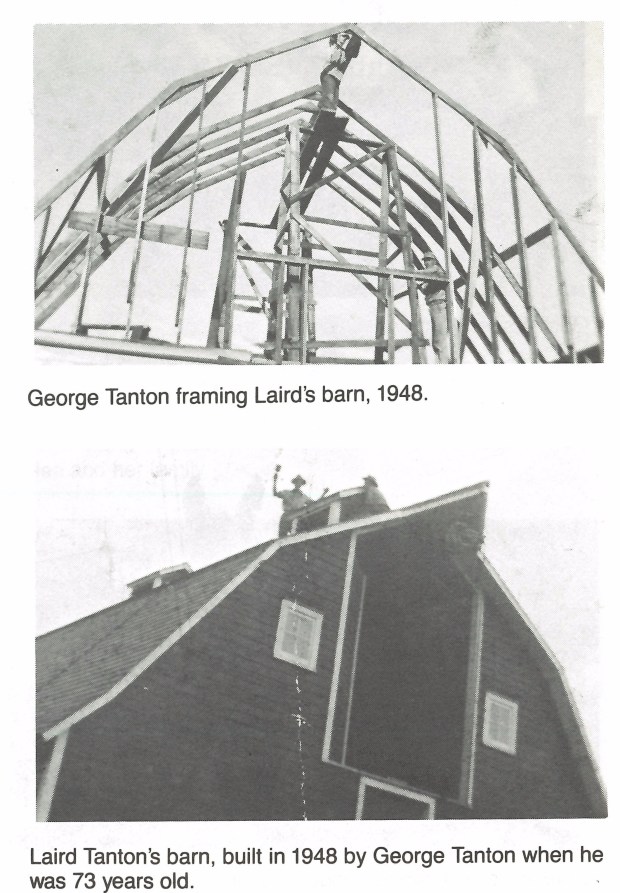
The property this barn stands on is thought to have been first owned by Carl Mead and then by William Oscar and Lydia Simons. The Tanton family moved to the property this barn sits on in 1943. Laird and Thelma Tanton raised their five children on this farm: Ron (’41), Lloyd, Marilyn, David, and Joyce (’52). This barn was built to replace the original barn on the property, which had a roof that was sagging horribly. It was built in 1948 by George Tanton, Laird’s father. You can read more about the George Tanton family at the end of this profile. In the beginning, the Laird Tanton family raised only enough livestock to feed their own family. But, as time moved on, they were slowly able to increase the number of milk cows, pigs, and chickens they raised.

For the much of its use, this barn has had the phrase “PARKVIEW FARM” painted on the southern slope of the barn’s roof. This farm’s name originates from the old Park School. This barn stands on the same quarter of land upon which the old Park School District schoolhouse used to stand on. Laird Tanton caught the family’s hired-man sitting on the roof of this barn, gazing to the eastward, trying to spot Park School’s beautiful teacher. Laird Tanton noticed this and decided it would be amusing to name the farm “Parkview Farm” after the incident.

The children of Laird and Thelma have many fond memories of their time with this barn. Ron recalls how his youngest sister, Joyce, would read bible passages to the milk cows, but it seemed to him that her bible was always problematically held upside-down. Additionally, Joyce had a way with horses. Specifically, Ron remembers this one pony that could not be easily handled by anyone except for her. Ron also shared that, one time, his brother, Lloyd, forgot to shut the pen’s gate in the evening after handling the cattle. It was the middle of winter and most of the family was asleep by the time Laird Tanton noticed the stock had gotten out into the farmyard. Promptly, Laird woke Lloyd up and sent him out to catch the cattle without shoes on. Lloyd remembered that lesson for a long time and never forgot to lock the pen gates again. Marilyn shared that she didn’t often go out into the barn because most of what went on in there was “men’s work”. However, she does remember how the family used to butcher their cattle in the barn. Marilyn had the disagreeable task of stirring the pot of blood the family collected for blood sausage. She would stir the pot as the blood was collected and then stir it as it was brought into the house for Thelma to make the sausages. Ron also shared how he would spray milk for the barn cats while milking the cows and how the barn’s pigeons were perfect target practice with BB guns.

In 1967, Lloyd and Sheila Tanton began living on this property. They had five children: Louise (’68), Michael, Gary, and a set of twins, Raymond and Craig (’75). The family used the barn for milk cows and sold cream in Sedgewick for a time. They also had pigs, chickens, and horses. Shelia remembers her children playing in the loft of the barn. Today, she humorously questions whether swinging around the loft on the hay carrier’s rope or jumping out of the loft was actually a safe idea. She is glad that no one ever got hurt and that so many good memories were made by her children in the barn.

In 2005, Craig and Tara Tanton began living on this property. They had three children: Emily (’02), Shelby (’03), and Cabrie (’08). Just a few weeks ago, Tara caught her kids and their friends jumping out of the loft of the barn into a pile of hay they created. Craig and Tara use the barn for storage of hay bales and miscellaneous items. They currently have 4 cow-calf pairs that sometimes use the barn. In 2007, the roof had tin put on to replace the original cedar shingles. In 2011, the outside of the barn was repainted to protect the original shiplap siding.

Tanton, Marilyn, Ron, Shelia, & Tara. Personal communication. 19 Jul. 2017.

IMG_0002

This frame shows the northern half of the barn’s roof and part of the western face of the barn. Notice the hay hood and hay track at the peak of the main barn’s roof.

IMG_0003

This frame is a close-up of the barn’s cupolas.

IMG_0006

This frame shows the western face of the barn.

IMG_0008

This frame shows the western face of the barn and part of the southern side of the barn’s roof.

IMG_0013

This frame is of the southern half of the barn’s roof.

IMG_0024

This frame shows the southern side and the eastern face of the barn.

IMG_0017

This frame shows the opening for the hay carrier’s rope. This hole is on the south-eastern corner of the main barn.

IMG_0022

This frame shows the southern side of the shed addition.

IMG_0025

This frame is of the eastern face of the barn.

IMG_0029

This frame shows the southern stalls inside the barn. The corner in the background is the south-eastern corner of the barn.

IMG_0034

This frame shows the eastern door on the ground floor of the barn. All of the stalls have been removed from this barn.

IMG_0033

This frame shows the northern half of the barn. This area used to have milking stalls. The unpainted door in the background of this frame leads to the shed addition on the eastern side of the barn.

IMG_0038

This frame shows the rest of the northern side of the barn.

IMG_0052

This frame shows the inside of the western face of the barn.

IMG_0054

This frame shows the south-western cupola ventilation chute. It used to let air move from the ground floor up to and out of the cupola in the barn’s roof.

IMG_0056

This frame is of the eastern face of the barn. Notice the hay carrier in the peak of the roof.

IMG_0048

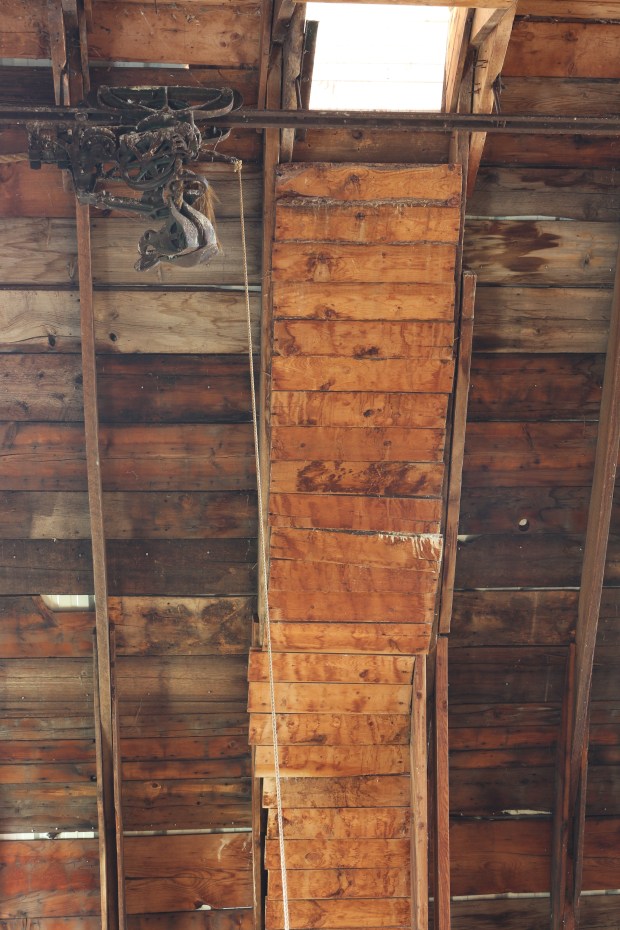
This frame is a close-up of the barn’s hay carrier.

IMG_0062

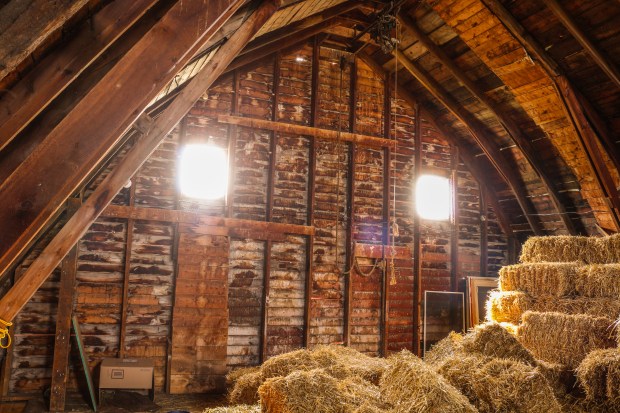
This image shows one of the hay chutes up in the loft of the barn.

IMG_0064

This frame shows the inside of the eastern shed addition.

Tanton Aerial Photo 1

Tanton family farm circa 1960.

Tanton Aerial Photo 2

Tanton family farm circa 2005.

Tanton Aerial Photo 3

Tanton family farm circa 2009.

building-barn-sedgewick-book-778.jpg

“Farm Buildings”. Sedgewick Sentinel: A History of Sedgewick and Surrounding                          Districts. 1st Ed. Sedgewick: Sedgewick Historical Society, 1982, pg. 778. Print.

Location

52.815621, -111.583463                  SE 30-44-12 W4

Characteristics

Barn Condition: Good

Construction Date: 1948

Features: Two wooden cupolas

Roof Shape: Gambrel

Paint: Red with white trim

Decorations: Used to have “PARKVIEW FARM” painted on the southern half of the barn’s roof

Roof Covering: Metal

Siding: Wooden shiplap

Foundation: Cement

Additional History on the Property

History on George and Janet Tanton & Laird and Thelma Tanton

“Tanton Family History”. Sedgewick Sentinel: A History of Sedgewick and Surrounding                             Districts. 1st Ed. Sedgewick: Sedgewick Historical Society, 1982. Print.

History on Park School

“Park School”. Sedgewick Sentinel: A History of Sedgewick and Surrounding Districts. 1st             Ed. Sedgewick: Sedgewick Historical Society, 1982. Print.

History on William Oscar and Lydia Simons & Carl Mead

Eastly, A.W. “William Oscar and Lydia Simons”. Sedgewick Sentinel: A History                               of Sedgewick and Surrounding Districts. 1st Ed. Sedgewick: Sedgewick Historical                 Society, 1982. Print.

Kroetsch

History

This 40 x 30 ft. gambrel-roofed barn was built in 1925, most likely by Barney Schares. It is one of two barns that currently stand in the Kroetsch family’s farmyard. You can view the other barn by clicking here. The barn pictured below was built with drop siding, cedar shingles, a hay hood, a hay sling, a large hay door on the south side, and a cupola. Many generations of children have ridden on the hay sling, probably much to the dismay of their parents. Like many barns of that era, the hay loft was used for feed storage and the barn was used mainly for horses.

In 1941, Adolph Kroetsch purchased the property from the estate of his grandparents, Henry and Anna Kroetsch. Henry Kroetsch was from Bruce County, Ontario. Henry bought the property from Christian Hishemoller in 1914.

After Adolph and Verna were married, the barn was used for milking cows, with the cream being sold. The cows were tied in the old horse stalls. There were a few horses, calves, and pigs on the western side of the barn as well. In 1963, the horse stalls were taken out of the eastern side of the barn and milking stanchions were installed. Cement was poured in the eastern side at this time as well. A milk house was built on the eastern side of the barn to house the cream separator. In 1965, the horse stalls on the western side were removed and cement was poured. Horse and calf stalls were then reinstalled.

When the severe snow and ice storm came in May of 1965, the power was out for 4 or 5 days. Adolph, the ever-resourceful farmer, hooked the milking machines up to the windshield wiper vacuum pump on the 1954 Ford car, and was able to run the machines with that. Some neighbours brought their milk over to use the hand crank cream separator.

Colin Kroetsch remembers his parents’ having a card party on a fall evening with some of the neighbours. He, Gary Sunderman, Rodney Strauss, and Brian Kroetsch decided to entertain themselves. His mom had finished harvesting the garden corn, and there was a tub of corn cobs waiting to be fed to the pigs the next morning. A corn cob fight ensued in the barn. Although the boys received no injuries, the same cannot be said for the barn windows. Colin did not break the news to his dad until the next morning. His dad responded by saying, “At least you guys were out of our hair!”

In 1973, a lean-to was built on to the eastern side of the barn. In 1976, Colin and wife Barb purchased the property from his parents. They continued to sell cream. Colin and Barb decided to go out of the cream business and started to ship bulk milk, so in 1978, a new milk house was built on the western side of the barn. A water and sewer system were also installed. The bulk milk tank and milking equipment were housed in the western addition. A vacuum milking system was installed in the barn at this time as well. A holding pen (16 x 64 ft.) was built on the northern end of the barn and was used to funnel cows into and out of the main barn for milking. A loose, enclosed housing barn (140 x 44 ft.) was attached, perpendicular to the northern end of the barn, and running to the east. Thus the cows could stay in the barn during the winter.

After the trusses were purchased, Colin dug some 8 foot railroad ties 4 feet down. He attached heavy tin to the railroad ties on the inside of the barn. Colin, his brother, Blair, and other helpers built the 5 foot stub walls. The railroad ties were cut off evenly and a wood plate was put on the top to attach to the stub walls. Colin and Adolph built the 6 foot walls. All the walls were built in sections, sheeted, and numbered. Thus they could be installed in order. In the fall of 1978, Richard Gramlick and his crew from Bashaw (which included Colin’s Uncle, Henry Toth) were hired to put up the trusses, install the walls, and tin the roof of the loose housing barn. Colin built the holding pen after the crew was done building the loose housing barn. Around 1994 or 1995, Richard Kroetsch and his helper, Brian Bendfeld, were hired to tin the roof of the original barn, the roof and exterior walls of the holding pen, and the roof of the newer milk house.

Colin and Barb shipped bulk milk for close to 20 years, but in the mid 1990’s, decided to sell the milk cows and concentrate on the beef herd. The milking equipment was removed and the barn was outfitted for calving out beef cows. A maternity pen was put in and stalls were built. The barn has been used for this purpose since then. In 2014, cameras were installed in the barn to assist with calving. These have been a wonderful investment, as they save many trips out to check cows.

The milk house is used extensively during calving season for storing medications, keeping records of calf births, and occasionally warming up a chilly newborn calf. The milk house has also become a “butchering shop”. Although they no longer slaughter chickens, Colin and Barb’s family still get together every year to cut up beef and make pork sausage.

The barn has been painted several times over the years. Colin’s mom, Verna, notes that the barn was built the same year that she was born. Verna also says “The barn, like her, looks better with a coat of paint!”

Kroetsch, Colin and Barb. Personal communication. 27 Jul. 2017.

Kroetsch, Colin and Barb. Wagon Trails in the Sod: A History of the Heisler Area: Volume           II. 1st ed. Heisler: Heisler Community Historical Society, 2017, pg. 640-641. Print.

_MG_9412

This frame shows the southern face of the barn and part of the eastern half of the barn’s roof. Notice the single metal ventilator on the roof of the barn.

_MG_9415

This frame shows the southern face of the barn.

_MG_9439

This frame shows the door to the shed addition on the eastern side of the barn.

_MG_9417

This frame shows the southern face of the barn and part of the western have of the barn’s roof.

_MG_9420

The addition on the western side of the barn used to house all of the equipment for the vacuum milking machine.

_MG_9422

This frame shows the western side of the corridor between the main barn, which was used for milking, and the pens outside of the barn, which was used for summer grazing.

_MG_9423

This frame shows the eastern side of the barn’s roof.

_MG_9426

This frame shows the corridor between the main barn, in the left aspect of this frame, and the enclosed holding area, in the right aspect of this frame.

_MG_9428

This frame allows for a more complete view of the eastern side of the barn.

_MG_9429

This frame shows the southern side of the enclosed holding area.

_MG_9500

This frame shows the eastern end of the enclosed holding area.

_MG_9434

This frame shows the door to the western addition inside the main barn.

_MG_9431

This frame shows the stalls on the western side of the main barn.

_MG_9432

This frame shows the walk-way between the two sets of stalls in the main barn.

_MG_9433

This frame shows the stalls on the eastern side of the barn.

_MG_9436

This frame shows the staircase to the barn’s loft and the chop bin on the eastern side of the barn.

_MG_9460

This frame shows the separating fence between the two corridors in the northern half of the barn. The incoming milk cows would come from the left, get milked inside the main barn. and then the outgoing cows would leave to the right.

_MG_9465

This frame shows the enclosed holding area – the area the outgoing cattle enter when they leave the milking room.

_MG_9468

This frame shows the trusses that create the roof of the enclosed holding area.

_MG_9477

This frame shows the staircase to the loft of the barn.

_MG_9472

This frame is a close-up of the hay carrier in the peak of the barn’s roof.

_MG_9474

This frame shows the trusses that create the gambrel roof shape.

Location

52.622563, -112.234788                    NW 15-42-16 W4

Characteristics

Barn Condition: Good

Construction Date: 1925

Features: Hay hood, hay carrier, and hay track and one metal ventilator

Roof Shape: Gambrel

Paint: Red with white trim

Decorations: No names or dates

Roof Covering: Metal

Siding: Drop siding

Foundation: Cement

Additional History on the Property

For more information on the Kroetsch family please see: 

Wagon Trails in the Sod: A History of Heisler and Area; Volumes I and II. 1st ed. Heisler:                    Heisler Historical Society, 1982. Print.

Aerial Photos

Kroetsch Farmyard 1956

Kroetsch Farm in 1956.

Kroetsch Farmyard 1960

Kroetsch Farm in 1960. Colourized with paint.

Kroetsch Farmyard 1976

Kroetsch Farm in 1976.

Kroetsch Farmyard 1981

Kroetsch Farm in 1981

Kroetsch Farmyard 1988

Kroetsch Farm in 1988.

Kroetsch Farmyard 1996

Kroetsch Farm in 1996.

Kroetsch Farmyard 2011

Kroetsch Farm in 2011.

Please click here to view the other barn in the Kroetsch family’s farmyard.

As well, please click here to view third barn that the Kroetsch family owns.

Marcinkoski

History

This barn was built in 1939 by the Marcinkoski brothers: Ludwig, Edward, and William. The barn was built before the house or anything else in the yard. It is possible that Arch Sather helped with construction of the barn as well because he was a neighbour and helped build the Marcinkoski’s first house.

Ludwig Marcinkoski owned the land this barn stands on and used the barn for mixed livestock. He had horses in the early days for completing farm work but also had pigs, chickens, milk cows, and beef cattle. Specific pens and stalls were built to accommodate their needs. Additionally, there used to be stanchions in the shed addition for milking cows. Ken Marcinkoski, Ludwig and Lousie’s son, remembers sleeping in the loft of the barn with the thrashing crew during harvest. As well, Ken vividly remembers cutting his lip on the ladder to the loft when he was 4-years-old. At the time, it hurt terribly and the memory stuck.

In 1981, Jim and Irene Marcinkoski came to the land to live with Jim’s parents, Ludwig and Louise Marcinkoski. Jim and Irene used the barn for sheep and, when they had their own children, for 4-H calves. The family still uses the barn for calving their cows.

This barn is interesting because it was built in 1939 and has an arched roof created using thin stacked lumber. Most arched roofs with glued-laminated timbers aren’t seen until the late 1950s/early 1960s. Before this, a few arched-roofed barns were built in this area using special patterns and cut wood – an example is the Kuefler Barn. The Marcinkoski barn is the oldest arched-roof barn created using thin stacked lumber – very similar to glued-laminated timbers – in this database. It was built using frame construction, specifically balloon framing.

Marcinkoski, Irene. Personal communication. 24 Jul. 2017.

Marcinkoski, Ken. Personal communication. 28 Jul. 2017.

_MG_9361

This frame is of the western face of the barn. Notice the hay hood in the peak of the barn’s roof. This is decorative as there is no hay carrier or hay track in this barn. Additionally, in this frame you can see the field stones which make up the foundation of the barn. This barn does not have any cement in its foundation, making it susceptible to quicker degradation. 

_MG_9366

This frame is of the southern side of the barn. Notice the single wooden cupola on the roof of the barn.

_MG_9370

This frame is of the southern side and eastern face of the barn. The layout of the eastern face of the barn is very similar to the western face: two square windows, one bale door, and one sliding entry door. 

_MG_9377

This frame is of the eastern side and part of the northern half of the barn’s roof. You can see the shed addition much more clearly in this frame.

_MG_9381

This frame is of the northern side of the barn.

_MG_9382

This frame is a close-up of the barn’s cupola. Notice the lightning rod on top of the wooden cupola.

_MG_9391

This frame shows the stalls on the southern half of the barn. Some of the barn’s timbers have been damaged by rain; however, Irene Marcinkoski plans to tin the roof of the barn soon. 

_MG_9390

This frame shows one of the stalls on the southern half of the barn.

_MG_9392

This frame shows the east-west walk-way and the door on the western face of the barn.

_MG_9393

A close-up of the inside of the western barn door.

_MG_9386

This frame shows the stall in the north-eastern corner of the barn.

_MG_9387

This frame shows the stalls on the northern half of the barn.

_MG_9394

This frame shows the remaining stalls on the northern side of the barn. Notice the door to the northern shed addition in the background of the frame.

_MG_9395

This frame shows the inside of the shed addition. The wall in the background of this frame is the eastern face of the shed addition.

_MG_9396

This frame shows the space between the shed addition and the loft of the barn.

_MG_9407

This frame shows the eastern face of the barn inside the loft.

_MG_9401

This frame shows the posts which hold up the roof’s peak. Arched roofs need something to stop the roof from sagging with gravity. This barn uses posts but it is also common to install braces in the peak of the roof.

_MG_9399

This arched roof is unique because it was built much earlier than many other arched roofs in the area. It was built in 1939, making it the oldest arched roof in this database.

_MG_9404

This frame shows the western face of the barn’s loft.

Location

52.998862, -112.103172                   NW 27-46-15 W4

Characteristics

Barn Condition: Good

Construction Date: Believed to be 1939

Features: One cupola

Roof Shape: Arched

Paint: Red

Decorations: No names or dates

Roof Covering: Wooden shingles

Siding: Wooden shiplap

Foundation: Field stones

Nordstrom-Dragani

History

The barn featured in this profile is located on the quarter-section of land which was homesteaded by Peter Nordstrom in 1905. Peter came from Sweden to the Revelstoke area in British Columbia in 1904. Peter heard of nearly free land in Alberta and made plans over the 1904-1905 winter to homestead in Alberta. You can read more about Peter and the process he went through to acquire land and build a homestead at the end of this barn profile.

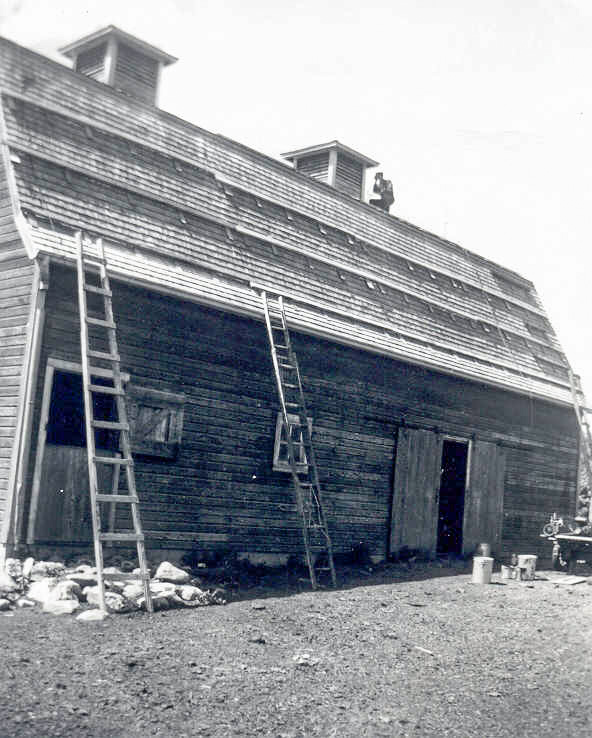
In 1927, the foundation was laid for the barn. This barn was intended to replace the original gable-roofed barn which had been built some years earlier on a different site on the farm. In 1928, the upper part of the new barn was built out of fir lumber which had been ordered from British Columbia. The barn was built using frame construction and balloon framing. Peter Nordstrom hired Philip Nelson as the main carpenter for the barn and Gustaf Lundgren as an assistant. Gustaf had immigrated to Canada in the same year as Peter’s wife, Kristina.

The new barn was built with the use of hand tools only as there were no electric tools in those days. Albert Nordstrom, Peter and Kristina’s youngest son, liked to tell the story that his Dad and the other carpenters had to sharpen their handsaws every night to keep them in good working condition. Building the barn required a lot of skilled manual labor, but the builders knew what they were doing! The final product is a fine example of handcraftsmanship. It still stands strong and steady today, albeit still showing signs of weathering.

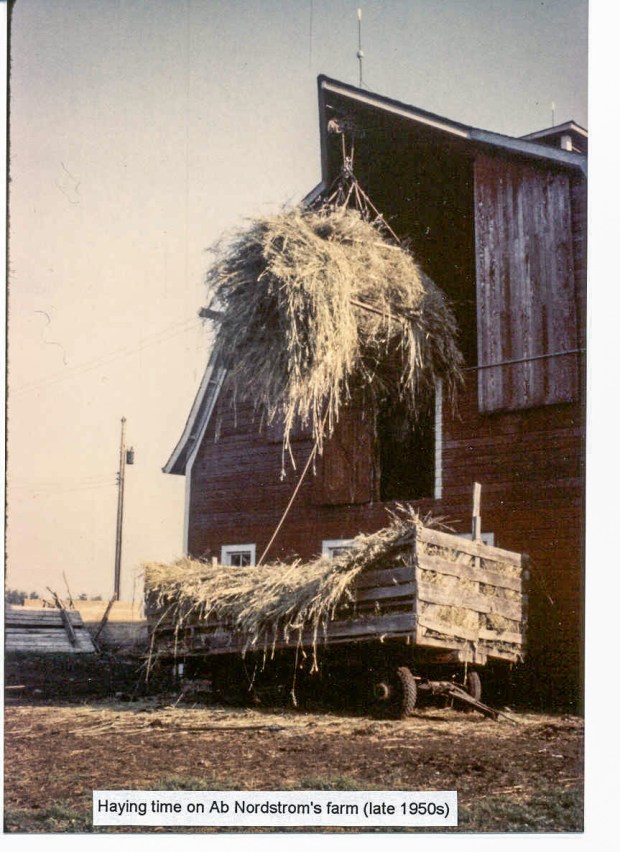
This barn brought a critical new piece of equipment to the Nordstrom farm – the hay carrier. Peter, and later his son Albert, liked to use three sets of slings when loading and unloading a wagon of hay. When a wagon was being loaded, one sling would be laid along the bottom of the wagon and covered with a layer of hay, then another sling would be laid on top of that layer and loaded with hay, followed by the third sling and a final layer of hay. When unloading the wagon, the slings would be attached one at a time to the hay carrier and then pulled up and into the loft by a team of horses or a tractor. It would take three trips of the hay carrier to unload a full wagon. When Albert took over the farm, he would often use his Ford tractor to pull the slings up and into the loft instead of a team of horses like his father always used.

If you wish to see a video of a hay carrier system in action or learn more about hay carriers please click here and scroll to the “Hay Carrier System” section. Finally, you can see a picture of the Nordstrom’s hay sling in action at the end of this profile’s photo section. Wayne Nordstrom fondly remembers not only operating the hay sling with his father, Albert, but also playing in the barn’s loft as a kid with his siblings when the chores were complete. Nothing like the smell of fresh hay in the hayloft!

Many different animals were kept in this barn over the years. When Peter first started homesteading he used oxen for his farm work but soon switched to horses. After the barn described in this profile was built, Peter not only used it to house his draft horses, as he no longer had oxen, but also his milk cows and some of the other farm animals. When Peter had the barn, he ran a mixed-farm operation with milk cows, beef cattle, pigs, sheep and chickens. Except for the brief period of time when Peter used oxen, all his farm work was done with horses. He never did own a tractor.

Albert Nordstrom, Peter’s son, took over the farm in 1952. From that point onward, most of the farm work was done with tractors and associated equipment. The farm was sold to the Dragani family in 1974. Domenico and Maria lived there until the fall of 2013. The Dragani family mostly used the barn for storing hay and other needs related to their beef cattle operation.

Nordstrom, Wayne. Personal communication. 19 Jul. 2017.

_MG_9090

This frame shows the southern face of the barn.

IMG_9102

This frame shows part of the foundation on the southern face of the barn. Peter Nordstrom built the foundation for this barn in 1927 and, with shaped pieces of wood inserted into the concrete, wrote the phrase “1927 PN,” except the “P” is backwards.

_MG_9085

This frame is of the southern face and eastern side of the barn.

_MG_9082

This frame shows the eastern face of the barn. The original barn used to stand in the foreground of this photo. You can see more of that original barn’s foundation at the end of this photo series.

IMG_9107

This frame is of the eastern side and northern face of the barn. Notice the hay hood and hay track. The hay would have been loaded into the barn from this side.

IMG_9109

This frame is of the northern face of the barn. The large loft doors slide down diagonally to open.

IMG_9112

This frame is of the northern face and western side of the barn. Notice the two large wooden cupolas. These cupolas are much larger than many of the other cupolas on other barns in this database.

IMG_9114

This frame shows the stalls at the southern end of the barn. The corner in this frame is the south-western corner of the barn

IMG_9115

The stalls inside this barn run north-south. This is unique because many barns have a single walk-way running the length of the barn with stalls lining the walk-way.

_MG_9118

This frame shows one of the stalls at the southern end of the barn.

_MG_9117

This frame shows the stall adjacent to the stall in the previous frame. These stalls were used primarily for milk cows and, when needed, draft horses.

IMG_9116

This frame shows the same stall as in the previous frame, but also shows the south-eastern entrance to the barn. Between the single stall and the barn wall is part of the north-south walk-way that traverses much of the length of the barn.

_MG_9121

This frame shows the north-south walk-way in the barn. This walk-way lets individuals travel between the stalls at the southern end of the barn and those at the northern end

_MG_9123

This frame shows the east-west walk-way adjacent to the stalls at the southern end of the barn. The walk-way provides access to the stalls (for feeding purposes) that are on both sides of the walk-way. Hay and other feed was thrown down through a hole in the loft floor located above the far end (the western end) of the walk-way.

_MG_9124

This frame shows some of the stalls used for milk cows in the northern half of the barn. The stalls were also used for draft horses, when needed.

_MG_9126

This frame shows the western side door as well as some of the stalls in the northern part of the barn. The side door and the one opposite it (on the eastern wall) are large, sliding doors. There is a large open walk-way in between the two doors, which is also visible in this frame. Note the wooden pegs on the vertical posts. These served as hangers for the horse harnesses.

_MG_9128

This frame shows the stalls near the northern wall that were used for milk cows and draft horses. An east-west walk-way between these stalls and the northern wall of the barn provides access to the stalls for feeding purposes. There is a hole in the loft floor located above the western end of this walk-way through which hay and other feed can be thrown down. A staircase to the loft is located just to the right of this frame.

_MG_9131

This frame shows the southern face of the barn inside the loft and the roof of the barn.

_MG_9149

This frame shows the hay sling and part of the hay carrier system near the southern face of the barn.

_MG_9150

This frame shows the barn’s roof and part of the northern face of the barn. The fact that this barn still has the rope for the hay carrier system is unique.

_MG_9083

This frame shows part of the concrete wall from the west side of the original gable-roofed barn that Peter Nordstrom built in this farmyard.

nordstrom barn_1928_barn contsruction_peter nordstrom on roof

This frame shows the construction of the barn in 1928.

nordstrom barn_1920s_peter nordstrom in photo

This frame shows the barn after construction in the late 1920s.

nordstrom barn_1948_albert nordstrom painting

This frame shows the barn being repainted in 1948.

nordstrom barn_1956_haying time

This frame shows the hay carrier in use about 1959.

nordstrom farm_1955_0001

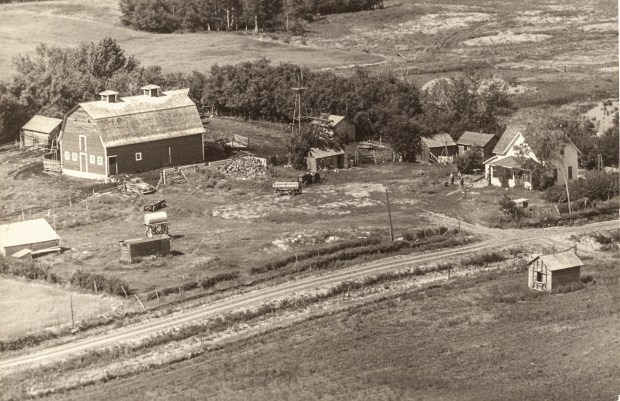
This aerial photo of the farm was taken in 1955 from the south-east.

nordstrom farm_1972_0001

This aerial photo is of the farm in 1972.

Location

52.874861, -111.625802               SE 14-45-12 W4

Characteristics

Barn Condition: Fair

Construction Date: 1927/1928

Features: Two cupolas, hay hood, hay carrier, hay track

Roof Shape: Gambrel

Paint: Red

Decorations: The phrase, “1927 PN” is stamped into the foundation on the southern face

Roof Covering: Wooden shingles

Siding: Wooden shiplap

Foundation: Cement

Additional History on the Property

Nordstrom Family History

Nordstrom, Ab. “Mr. and Mrs. Peter Nordstrom History”. Sedgewick Sentinel: A History          of Sedgewick and Surrounding Districts. 1st Ed. Sedgewick: Sedgewick Historical                Society, 1982. Print.
Additional information can be gleaned from Peter and Kristina Nordstrom’s biography, written by their grandson in 2014. Portions of that biography are shown below. Please click the tiles to enlarge them and, if needed, open the enlarged tile in a new tab to zoom in.
Nordstrom, Wayne. Per and Kristina Nordstrom – Their Story – From Sweden’s Trails to               Canadian Farm. 1st ed. Edmonton: Wayne Nordstrom, 2014. Print.